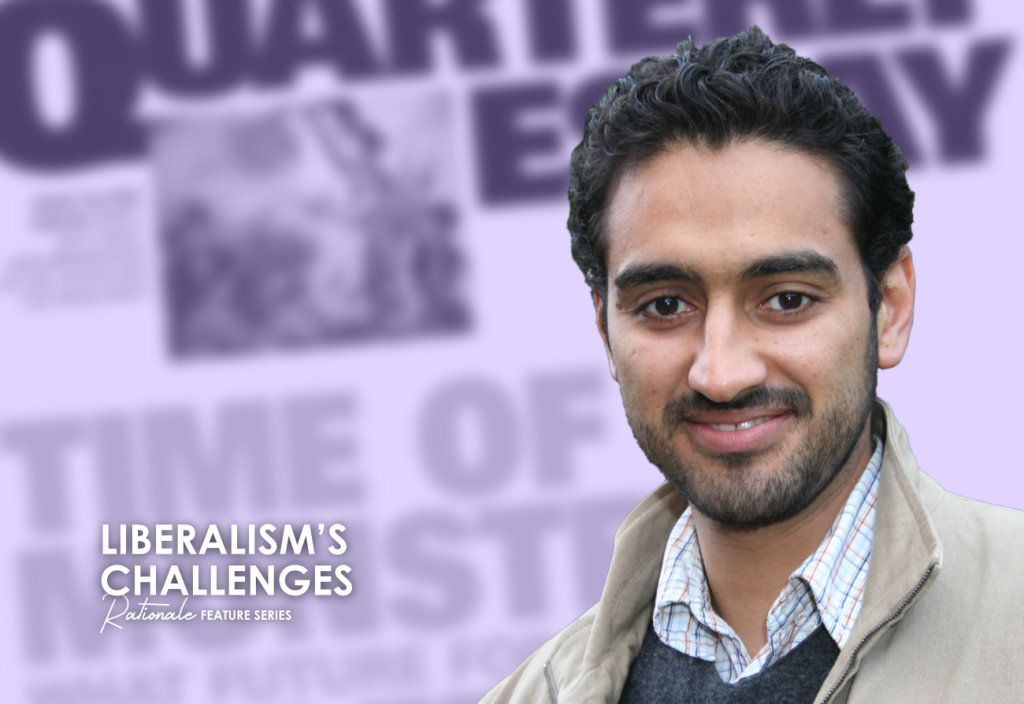

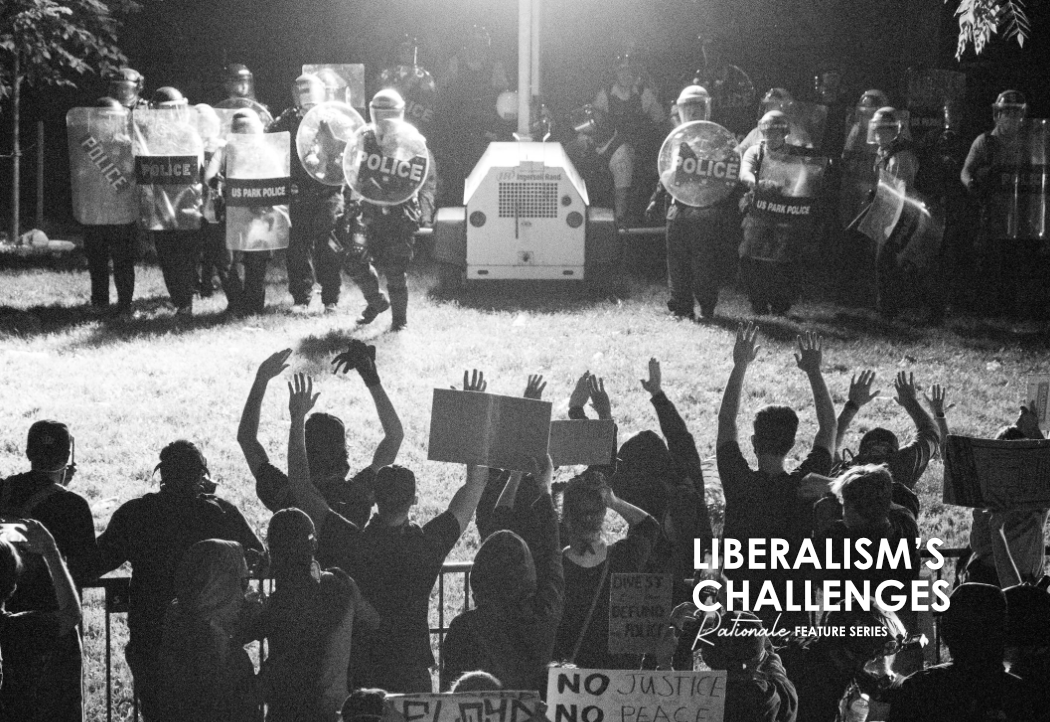
This article is part of a feature series, ‘Liberalism’s challenges’, reflecting on Waleed Aly’s Quarterly Essay, ‘Time of Monsters: What Future For Liberalism?’, and the state of liberal democracy more broadly. If you would like to contribute to the feature series with an article or respond with a Letter to the Editor, find out how to here.
Liberalism, the dominant ideology of the western world since the nineteenth century, might be in trouble. Political parties on both the Left and Right which reject liberal ideas are growing in support. More and more mainstream politicians openly reject the label ‘liberal’. US Vice President J. D. Vance, for example, describes himself as being “of the post-liberal Right”. In Australia, as in other countries, opinion polls show that support for democracy among young people, particularly young people without higher education, is declining.
Is liberalism doomed? On one hand, eulogies have been written for liberalism before. They appeared in the wake of the Napoleonic Wars, in the First World War, in the 1970s, and most notably, in the 1930s, when it seemed that the future belonged to either communism or fascism. “Is Liberalism dead?” asked an article in The Spectator on 26 May 1933, a common question at the time when totalitarian states seemed to have solutions to problems which the Depression-hit western democracies could not solve. In all cases, it survived.
On the other hand, sometimes the unexpected or even unimaginable does happen. The idea that the Soviet Union and entire Communist Bloc would collapse was a fringe theory until shortly before it actually occurred.
We have the haunting image of young women in skirts going to university in Kabul and Tehran in the 1950s as a reminder that progress can always be wound back. The question, then, is whether these predictions of liberalism’s demise were wrong or simply premature.
In the new Quarterly Essay, ‘Time of Monsters: What Future For Liberalism?’, Waleed Aly considers this question, and also considers whether today’s post-liberals offer a workable alternative to mainstream liberal democracy.
Aly begins with a readable account of the origins and history of liberalism, from the writing of Thomas Hobbes, John Locke and John Stuart Mill, through to the rise and fall of competing schools of liberal thought, such as postwar welfare state liberalism and the neoliberalism of the 1980s and 1990s.
Given the challenge in summarising liberalism in about 30 pages, it’s a solid overview. Many readers of the essay will be familiar with what Aly recounts, but many won’t – which is interesting, because these ideas are fundamental to the society we live in.
Ultimately, most of our mainstream political debates are within liberalism rather than between liberals and non-liberals. As Aly points out, no one school of liberal thought has managed to prevail, and so the debates continue.
Post-liberals
There are, however, those who think that liberalism no longer offers solutions to the problems our society faces, if it ever did in the first place. Aly refers to them, collectively, as post-liberals, distinguishing between Right- and Left-wing forms. The former is the conservative, nationalist and traditionalist post-liberal Right, and the latter exemplified by the criticism of mainstream liberal democracy provided by the social justice movement of the 2010s and early 2020s.
Liberalism is based on the assumption that the institutions of the state can be neutral arbiters of competing interests. To some modern progressives, though, it is impossible that these institutions can be neutral given the entrenched, unequal power structures in society. Aly quotes the maxim of Ibrahim X. Kendi, one of the key figures of the social justice movement, that there is no such thing as a non-racist policy, only a racist or an anti-racist one.
In Aly’s view, conservative post-liberals “think liberalism erodes the fundamental structures that make human flourishing possible, like shared culture, family and purpose in life”, while progressive post-liberals say it “entrenches an oppressive structure”.
Gathering up all of the Left- and Right-wing critics of western liberalism into a single post-liberal basket will probably be the most controversial aspect of the essay. A lot of people will no doubt object to a category which includes both Ibrahim X. Kendi and J. D. Vance. I think it is true that there are obvious similarities between liberalism’s critics across the political spectrum. That said, the term ‘post-liberal’ might be too broad, including a range of movements which openly see themselves as successors to or improvers upon western liberalism, as well as others, like religious conservatism, which have been fighting against liberalism for centuries already.
The Catholic Church is as much of a pre-liberal institution as a post-liberal one. Even ‘conservative post-liberalism’ is a very fuzzy category, stretching from Right-wing critics of free-market economics and libertarian social policy through to religious fundamentalists and ethnic nationalists. Some of the Right-wing post-liberals clearly have a problem with more than just the erosion of traditional structures – they have a problem with non-white immigration full stop. But the term ‘post-liberal’ works for the purposes of the essay.
Liberalism’s challenges
Liberalism faces a lot of challenges in the 2020s and, as Aly points out, “post liberals have a lot to work with”. Social atomisation, the disruption caused by COVID, climate change, the degradation of the environment, wealth inequality, concerns over immigration – all present potent challenges to liberal politicians.
In the essay, he focuses on two – social media and AI. Both are interesting examples because they were developed and have spread through fundamentally liberal principles, being technological progress and the freedom of the individual. At the same time, both have led to serious and complex problems.
Social media, for all its potential, has undeniably caused harms on both an individual and social level. People can become addicted to social media and reduced to mindlessly scrolling on their phones, isolated from real-world contact and in a downward spiral of poor mental health. More broadly, social media has allowed misinformation, conspiracy theories and political extremism to spread like a bushfire even among ‘normal’ people.
John Stuart Mill argued that we would use our freedom to pursue higher pleasures, such as art and literature. Many of us, though, we have used it to fritter away hours on Instagram and TikTok, or like and share unhinged rants on Facebook.
AI presents opportunities to drastically improve productivity and access to services. For example, legal AI agents can provide access to justice among those who cannot afford a lawyer. At the same time, it has produced a flood of AI slop, led to the construction of power-hungry data centres around the world, and threatens to replace human artists, writers and designers with machines.
Since the Industrial Revolution, automation has led to job losses. But, for the first time, the jobs being lost to automation are complex, white-collar roles demanding higher education, and some of the more interesting and rewarding jobs in society, like graphic design and copywriting. And the pace of change is frenetic. At the time I am writing this, ChatGPT is not yet four years old and already entry-level positions in fields like consulting are contracting sharply.
We have been able to tackle problems like global hunger and pandemics with technology and production. For example, developing vaccines and then producing them in huge quantities via our industrialised economy. We have overcome fascism and communism by promoting individual freedom. But these solutions will not work for the problems created by social media and AI. As Aly writes, “we got here by following certain liberal tracks, and we now face problems liberalism cannot solve, at least without reinvention.”
Does liberalism have a future?
Aly’s position is that the current forms of post-liberalism are unlikely to offer a workable alternative to western liberal democracy. In his view, Left-wing post liberalism is “exhausting to no achievable end”, while conversative post-liberals seem more interested in “prosecuting fairy standard right wing culture wars under another banner” than building a lasting alternative structure. In my view, both these observations are sound.
On the other hand, Aly “cannot imagine a final victory for Liberalism” either. He argues that liberalism’s survival is based in a “fundamental wager” that achievements such as the abolition of slavery and lifting millions out of poverty will prove both perpetual and sufficient. Ultimately, Aly argues, liberalism depends on humans being satisfied with expanded freedom and wealth, and he is not convinced this is the case.
The questions posed by ‘Time of Monsters’ may not be answered in our lifetimes, and if liberalism bounces back from its current challenges as it did after the 1930s then the current panic will naturally look overblown.
To refer to recent events, I am writing this after Democrats have won a decisive, even historic, victory in the US midterm elections. The successful candidates were generally mainstream liberal democrats, and the result was a serious setback for the post-liberal Right and a possibly fatal blow to MAGA. It’s obviously far too early to write off the populist, nationalist wing of the Republican Party. But, at the same time, it shows that it’s foolish to write off American liberalism. But elections due in France next year might lead to a very different outcome. It’s banal to point out that predicting the future is difficult.
Based on the name of the essay, Aly is clearly alarmed by liberalism’s enemies. The essay can be read, therefore, as a warning from a liberal to other liberals who may have become complacent. The fall of liberalism might not be guaranteed, but it is certainly conceivable. On that basis, those who want liberalism to stick around should pay attention to ‘A Time of Monsters’.
Published 14 November 2026.
If you wish to republish this original article, please attribute to Rationale. Click here to find out more about republishing under Creative Commons.
Image: Koshu (Unsplash)