
Annie Jacobsen is a bold investigative journalist and the author of a string of portentous books on the military and intelligence institutions of the United States and on the acute dangers humanity at large faces from weapons of mass destruction.
If you’re already addicted to asking artificial intelligence (AI), ask away. I had written the above summary before checking AI, and then got the following answer when I did:
Annie Jacobsen is a well-regarded investigative journalist and bestselling author known for her deeply researched books on national security, war, and government secrets.
Actually, expert human opinion is quite mixed.
Kai Bird, a fine historian of intelligence matters himself, has described Jacobsen’s work as too often sloppy and anecdotal. Richard Rhodes, another very competent historian (of nuclear weapons) has also been very critical of her work.
Nonetheless, her range is certainly striking, beginning with Area 51: An Uncensored History (2011), then Operation Paperclip (2014), The Pentagon’s Brain (2015), Surprise, Kill, Vanish: The Secret History of CIA Paramilitary Armies, Operators and Assassins (2019), and others.
But here I shall comment only on her two most recent books, Nuclear War: A Scenario (2024) and Biological War: A Scenario. (2026) – not to offer a close analysis of them but to recommend them as jolts to the moral and political imagination.
We live in a world in which massive nuclear arsenals and secret arsenals of biological and chemical weapons exist and represent a deeply insidious danger to us all. Yet most of us live oblivious to either the scale or nature of those dangers.
Jacobsen shows just how dangerous they are – starting with straightforward scenarios of the rogue use of nuclear missiles, then exploring the leak from a Russian BSL-4 biosecurity lab in Siberia of a gain-of-function engineered pneumonic plague bacillus, and then showing in dramatic detail what consequences follow.
In Nuclear War, the scenario is very similar to the one dramatised in the feature film A House of Dynamite (2025), directed by Kathryn Bigelow of Zero Dark Thirty (2012) fame, in which an unknown enemy launches a nuclear ballistic missile at Chicago and the US President has to decide within minutes what to do – and cannot.
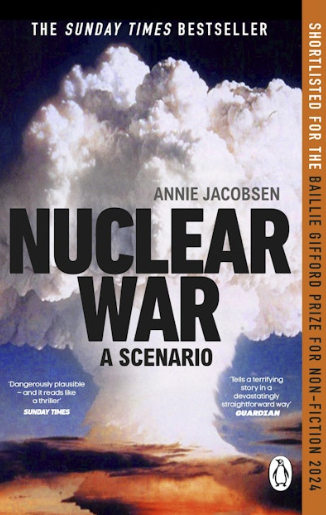
In Jacobsen’s scenario, two missiles are fired at the United States without a declaration of war by an unknown adversary, which it is deduced is surely North Korea.
In each case, the result is catastrophe.
Jacobsen, like Bigelow, steps us through the intense time pressure and uncertainties, the failure of missile defence and the nature of the nuclear impact. Jacobsen adds the decision that Bigelow omits: massive retaliation against North Korea – which is read by Russia as an attack on it, triggering a massive retaliation of its own and Armageddon.
This is not the place to pick apart the scenarios themselves. Rather, it is an opportunity to urge that you read this book (and see the film) and then become serious about comprehending the cliff’s edge existence we all now live in the name of nuclear deterrence, especially as global order, economic and geopolitical, deteriorates.
Of the many books on the subject (I have two long shelves full of them), I recommend starting with Daniel Ellsberg’s The Doomsday Machine: Confessions of a Nuclear War Planner (Bloomsbury, 2017).
Biological War: A Scenario is a similar provocation to think harder about the dreadful danger from biological weapons. In this case, the scenario is closely based on both the outbreak of COVID-19 in Wuhan in 2019 and the Chinese government’s cover-up, as well as on several accidents in Soviet bio-weapons labs during the Cold War, in which unknown numbers of people died.
But Jacobsen ups the ante. She creates a scenario in which an engineered pneumonic plague bacillus escapes from a BSL-4 laboratory in Koltsovo, Siberia, and spreads globally within 24 hours.
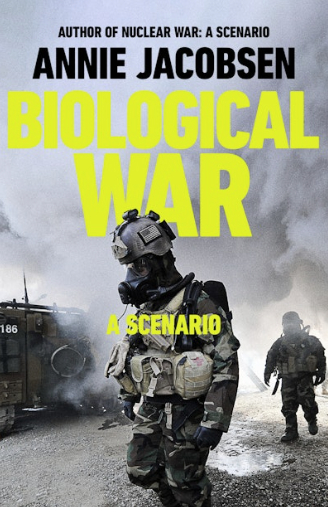
The Russian government tries to cover up what has happened. But the pathogen is highly virulent and there are no antidotes. The consequences, which Jacobsen centres in the United States, are catastrophic.
If you want a dramatic contemporary story with geopolitical ramifications, read the book. But it is a scenario, not an analysis or a documentary as such. It is a wake-up call, not a dispassionate report. And it has been criticised on these grounds – as being a thriller rather than a sober inquiry.
‘Thriller’, however, is the wrong word. Jacobsen has drawn on wide expert advice and the writings of highly credible authorities in putting her scenario together. Her intention is to alarm us. If you want an equivalent ‘real world’ analysis of the danger of biological weapons on the same level as Ellsberg’s The Doomsday Machine, I recommend Ken Alibek’s Biohazard (2000).
Ellsberg worked on nuclear war strategy for the RAND Corporation and the Pentagon. Ken Alibek (Kanatzhan Alibekov) was deputy director of the Soviet Union’s immense, illegal and totally secretive biological weapons program, Biopreparat, in the 1980s.
Uncannily, just as I was preparing to write this column, there was a reported leak of plague bacillus from a Russian BSL-4 biological weapons laboratory in Siberia – in Irkutsk, close to Lake Baikal. The Putin government is being secretive about it. But it has been reported that 200 people have been quarantined after a scientist died when she broke a test-tube containing the bacillus and inhaled some of the pathogen.

As biodefence specialist Alex Washburne wrote this week, the official version doesn’t stack up: “The scale of the response suggests some aspects of the official story are almost certainly untrue.”
The only good news is that this version of pneumonic plague is not the one imagined by Jacobsen in her scenario. It is much less virulent. But those who inhale it, if left untreated, will, in 100 percent of cases, die within one to three days. And Irkutsk facility did house a weapons research lab, according to no less an authority than Ken Alibek. Imagery analysis suggests it still does.
This is the real world Jacobsen has gone to considerable effort to ring the alarm bells about.
If you wish to republish this original article, please attribute to Rationale. Click here to find out more about republishing under Creative Commons.
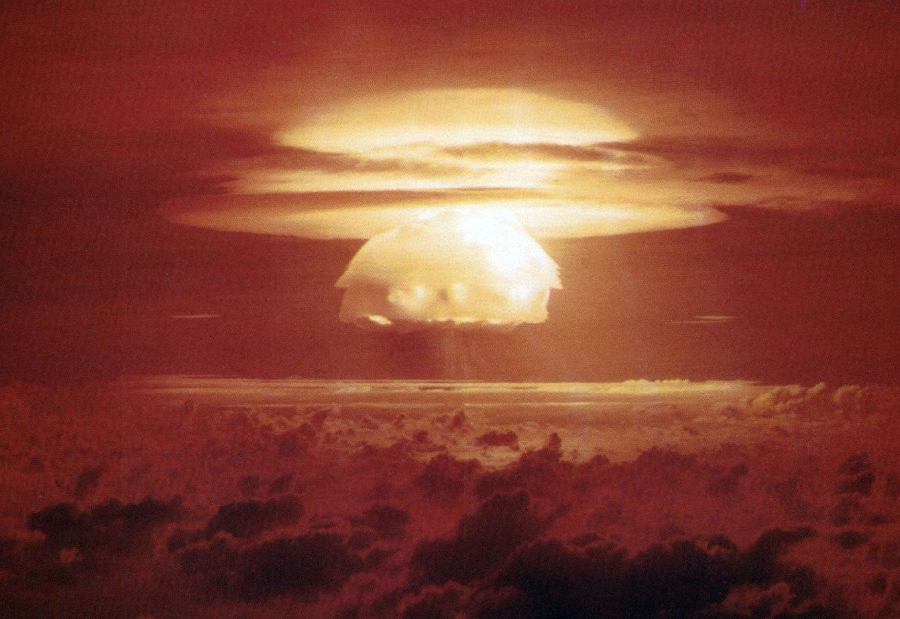
Photo by United States Department of Energy (Wikicommons).