
One of my favourite movies, even though the ending is fantastical, is The Martian. Its hero is a botanist. He decides to “science the shit” out of the problem when he is stranded alone on the planet Mars. The ‘martian’ states that “Mars will come to fear my botany powers!”
Not many heroes are botanists. Joseph Banks was one. Upon returning home after his long sea voyage to the Antipodes with Captain James Cook, Banks was lauded partly due to the amazing specimens he collected in Australia. While brilliant, he was, by all accounts, a complex, flawed character who exploited people of other races, and was quite callous.
In the first paragraph of the foreword to the wonderful new book, Atlas of Botany, it says the following: “Plants have become adept at making modifications to suit their circumstances.” But what is wrong with that statement?
The statement is designed to excite ordinary people about plants. The problem is that the statement misrepresents evolution. Evolution is a process not a destination. Plants have no concept of the future. There is no agency, and no intended direction to produce the greatest organism in the world or even survival for that matter. Evolution either happens or it doesn’t. This may mean an organism becomes extinct, changes, or, like the stromatolites of Shark Bay, more or less goes on forever.
If they didn’t read the rest of the book, with its clear explanations of the evolution and nature of land plants, readers could imagine a plant getting blistered leaves from too much sun and sprouting a crown of really tough leaves to act as a parasol.
But, to describe this example more accurately, you would say that plants that tend to have a thick crown of tough leaves were more likely to survive as their tender leaves were not as sunburnt as plants which do not have crowns.
Anthropomorphising – or given a human perspective to things – is a common strategy when science people write for the public. Authors use it to make a topic more relatable. Humans crave agency and purpose. They often expect there will be a comforting reason for things being the way that they are.
At its core, anthropomorphising has the concept that other living things are like us. It is deeply misleading but very common – in fact all pervasive.
Plants have starring roles in two other movies I am fond of – Lord of the Rings and Avatar. I love the way the Ents, or tree herders, are presented in Lord of the Rings, and the idea that trees can talk to each other and move to kill orcs. In Avatar, I love the weird and luminescent plants, and the trees that store memories and communicate to other living things.
Alas and alack, real trees are not sentient. They do not think and feel as we do. They do not have brains or nerves. And, in fact, they are made of fairly simple tissues – xylem, phloem and pith. The things they do are governed by biochemistry through a complex, microscopic web of chemical reactions. These drive energy production through photosynthesis, resource usage through cellular respiration, and growth and form through plant hormones.
At the boundaries of the plant, there may be chemical reactions taking place with the soil and other living organisms.
Atlas of Botany is a valuable source for learning about trees and other land plants. It is beautifully illustrated, full of interesting details and clearly explained. It is divided into short sections, so it is easy to read.
The book describes the origin and evolution of land plants, how they changed the environment and how the environment changes them. It shows where different plants live and how they work and have sex. It is an enjoyable refresher on botany.
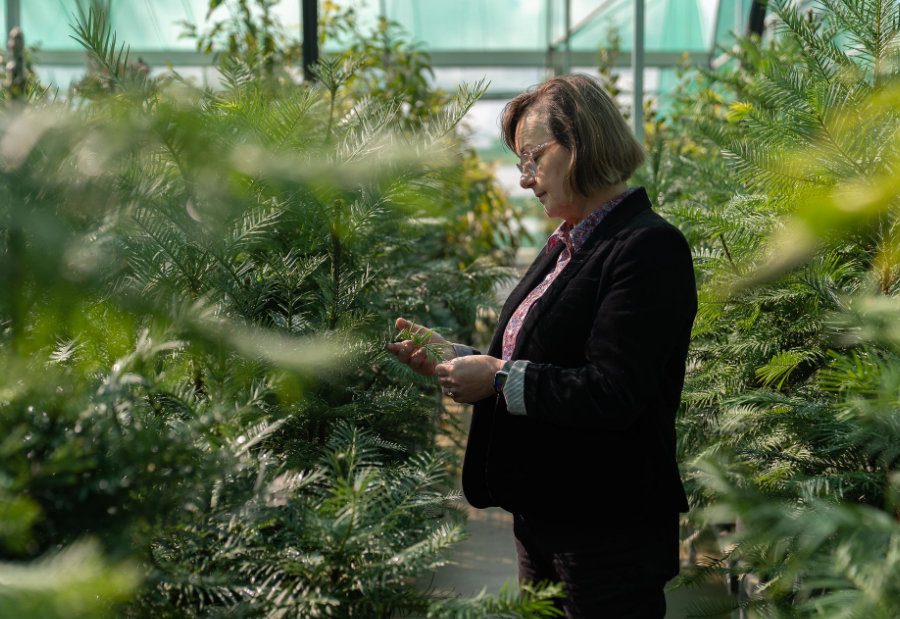
It even mentions that Australian miracle, the Wollemi Pine, which was discovered in a small, narrow valley in the Blue Mountains in 1994. In fact, it is not a pine; it is a member of the Araucariaceae family. There are three genera – Araucaria, Agatha, and now Wollemia. The last genus has only one species – our own living fossil Wollemia nobilis.
To me, the idea that a grove of trees which evolved perhaps 55 millions of years ago could still exist in a tiny patch of forest near a very large city is mind-blowing.
The attempt to preserve Wollemia nobilis, one of the rarest and most significant trees in the world, shows all sides of human nature. There were the people who brought them to the attention of science, the botanists who identified them, and the National Parks Service who tried to protect the wild trees by not disclosing their location and by restricting all public access.
In 2005, some people, perhaps driven by insatiable curiosity, tramped into the narrow valley and introduced the virulent water mould Phytophthora cinnamoni to the pristine area. Perhaps they thought the rules didn’t apply to them.
There were the specialist firefighters, supported by the Rural Fire Service, who saved the trees from bushfires in 2019-20. Then there were the botanists that cloned the trees, the nurseries that sold them, and ordinary people who bought them, thus helping to ensure that the species survives.
The Araucariaceae family of trees is very special. Its members grew in the time of the dinosaurs. They look strange. And the distribution of the family across the globe helped prove continental drift – and, from that, plate tectonics.
Plants can conquer a planet. But, unlike us, they are not driven to do so.
Published 20 September 2026.
If you wish to republish this original article, please attribute to Rationale. Click here to find out more about republishing under Creative Commons.