
One of the many untruths propounded by the Judea-Christian religious tradition is the concocted story that, one day on Mount Sinai, God gave Moses the Ten Commandments. But the actual phrase ‘Ten Commandments’ does not appear anywhere in the Hebrew text of the Bible.
Archaeologists are now pretty certain that Moses didn’t exist, at least as far as being the hero of the story told in Exodus is concerned – the escape from captivity in Egypt and crossing the Red Sea and getting the tablets from God and so on. There is absolutely no evidence for a Jewish captivity in Egypt at that time (or at any other), let alone a miraculous escape.
But worse than that. There are, in fact, not 10 commandments. There are a number of commandments allegedly given by God to the non-existent Moses, but when you count them there are not 10 but 12. Or 13 if you count the introductory phrase as a separate commandment – which the Jewish faith does. This verse turns out to have been a lie by God: “I am the Lord your God, who brought you out of Egypt, out of the land of slavery” (Exodus 20:1). No, you didn’t! They were never there.
A commandment is just a fancy way of saying a command, and there is no denying that in the two Biblical passages listing God’s alleged commandments to Moses on Mount Sinai (Exodus 20: 1 – 17 and Deuteronomy 5: 6 – 21) there are actually 12 separate injunctions or commands, not 10.
So what’s the big deal about 10? What’s wrong with having 12? Why not acknowledge the 12 and leave it at that?
Two things. First, according to the Ancients, 10 was the number. It was “the number of completeness and perfection”. It denoted a return to unity and thus symbolised spiritual achievement. Greek mathematician Pythagoras noted that 10 was the sum of the first four natural numbers (1 + 2 + 3 + 4 = 10) and called it “the holiest of numbers”.
To many, it represented the totality of the universe (see Annemarie Schimmel’s The Mystery of Numbers). So there just had to be exactly 10 commandments.
Second, the Old Testament itself later says (Exodus 34:28), probably with the mystical importance of 10 in mind, that the Covenant with God, of which the commandments are a key part, is based on the “ten matters”:
And he is there with Jehovah forty days and forty nights; bread he hath not eaten, and water he hath not drunk; and he writeth on the tables the matters of the covenant – the ten matters. (trans. Robert Young)
The “ten matters” of the Covenant are referred to again in Deuteronomy 4:13 and 10:4. So it seemed imperative that the 12 injunctions listed in Exodus 1 be somehow wrangled into a canonical 10 commandments, at least for the sake of consistency. Although consistency is not a quality for which the Bible is particularly distinguished.
To accomplish this, religious leaders determined that some commands that look like discrete commands are actually linked injunctions, parts of single commandment with more than one aspect. So low and behold now there are indeed only 10 commandments. That sounds convincing.
Until you look at the results. Each major religious tradition has arbitrarily divided up the list of 12 commands in a different way in order to make a ‘Decalogue’. There is no one canonical way of counting the 12 commandments as 10.
And not one of the commands has a unique commandment number common to all three traditions. The closest is the last, but it is compromised. “You shall not covet your neighbour’s wife, or his male or female servant, his ox or donkey, or anything that belongs to your neighbour” is the 10th commandment in the Catholic schema. But, in the Jewish and Protestant systems, it is only the last part of the 10th Commandment.
In short, nobody wanted to have 12 commandments. There just had to be Ten. So they all fiddled the books according to their own lights to make sure that there were.
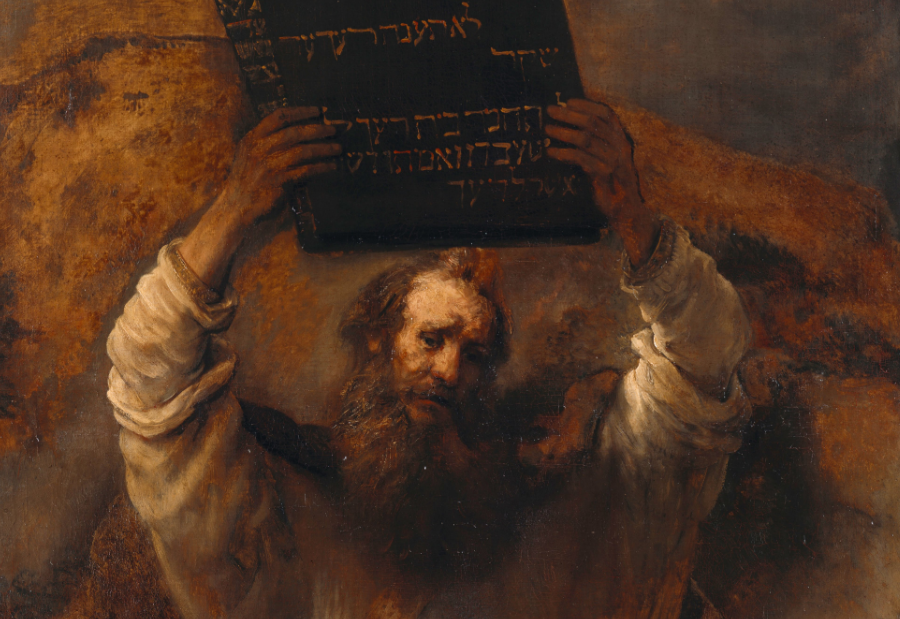
According to the Bible (Exodus 34:1 & Deuteronomy 9:10), all these commandments were written on two stone tablets by “the finger of God”. This is quite a feat, since two of them (numerical 3 and 5) are quite wordy, so they must have either been quite large tablets or the writing was very small.
The tablets had to be small enough for Moses to be able to carry two of them down from the mountain, so the second hypothesis is the most likely. The smallness of the writing might explain why the two scribes, the author of Exodus and the author of Deuteronomy, have transcribed different versions of two of the commandments (numerical 5 and 6), and have put the “thou shalt not covets” in a different order at the end.
In the greater scheme of things, the way in which the commandments are numbered is probably neither here nor there. The more important question is: Do they contribute anything substantial to the human race and its ethical deliberations? Do they add to the sum of human moral knowledge?
The first thing to notice is that the first five commandments are not really about the way we should behave towards our fellow humans, but about the way we should behave towards the God who gave them to us. So, strictly speaking, they are not ethical commandments at all, but religious ones.
Basically, they say we should make this God the top God, not make any images of Gods and not bow down before them, not misuse his name, and keep the seventh day holy. Mostly straight forward stuff, although he was a bit cagey about what his name actually is. And no two religions can agree on which is the seventh day because the calendar has changed from time to time.
The only major sour note is the second part of the third commandment, which does not put this deity in a good light:
… for I, the Lord your God, am a jealous God, punishing the children for the sin of the parents to the third and fourth generation of those who hate me.
He or she is not only jealous of any other Gods that may be around but also threatening to punish the people that worship them, their children, grandchildren and great-grandchildren. This is clearly unjust. How can anybody, even a God, justify punishing people who have done no wrong? And isn’t envy or jealousy one of the seven deadly sins?
But let’s put this to one aside and concentrate on the final seven commandments that do mandate ethical behaviour between humans.
He or she is not only jealous of any other Gods that may be around but also threatening to punish the people that worship them, their children, grandchildren and great-grandchildren. This is clearly unjust.
The thing that stands out is that all but one of these seven are prohibitions – “thou shalt nots”. The exception is “Honour your father and your mother”. The other six tell you not to murder, not to commit adultery, not to steal, not to lie about your neighbour and not to covet certain things that belong to your neighbour. So, apart from honouring your parents, there are no positive duties imposed on us, just a list of actions we should not undertake and thoughts we should not entertain.
At first glance, these prohibitions seem for the most part rather limited. The only absolutes are “do not steal” and “do not murder”, although the later leaves open the possible permissibility of other forms of killing, such as in warfare, or mortal combat or capital punishment.
The ethics of sexual relationships is restricted to prohibiting marital infidelity, although some Protestants do try to extend the concept of ‘adultery’ to include all sexual intercourse outside marriage. But there is nothing here about rape or sexual harassment or consent.
The prohibition about lying is even more specific – “you shall not give false testimony against thy neighbour”. It leaves open the possibility of other forms of looseness with the truth – which is just as well for politicians, public relations purveyors and the advertising industry.
The final prohibition is against coveting. Perhaps oddly, as with the prohibition against giving false testimony, the prohibition against coveting seems only to apply to possessions of your ‘neighbour’.
It begins by specifing a number of his possessions (your neighbour is, of course, a male) – his wife, his house, his land, his male or female servant, his ox, his donkey – and then makes the list redundant by concluding with the blanket statement “or anything that belongs to your neighbour”. God could have saved a lot of stone-work by simply saying “you shall not covet anything that belongs to your neighbour” and all the above items would be covered.
Moreover, this list implies that all the listed items, including the wife and the servants, are the neighbour’s possessions, which doesn’t fit well with contemporary ideas about marriage equality and the unacceptability of slavery.
It also raises some further questions. Firstly, who is your ‘neighbour’? Theologians are apt to get fairly evasive when attempting an exegesis of this concept, uncertain as to how wide to cast the neighbourhood net.
Does it mean the guy next door, or any member your tribe, or anyone you think of yourself as having genuine dealings with, or the entirety of, what they called back then, ‘mankind’?
If it is the latter, as some modern Christians have tried to argue, why include the possessor at all? Why not just say “don’t covet” (anybody’s anything)?
And, if the prohibition is to be, indeed, limited to the possessions of ‘neighbours’, who are the non-neighbours that the neighbours are being contrasted with? Who are those whose wives and possessions it is permissible to covet?
Secondly, the meaning of ‘covet’ differs somewhat depending on the object of our desire. Surely, the assumed male recipient of the commandments covets a woman (wife or female servant) in a different way to the way he covets a donkey or a parcel of real estate. The fact that the Hebrew word in question, chamad (חמד), can also be translated as ‘lust’ or ‘strong desire’, highlights this ambiguity.
Thirdly, the idea of not coveting conflicts drastically with contemporary economic theory. The whole edifice of modern capitalism is built on the principle of coveting, of wanting what you don’t have. And economic growth is dependent on consumers having the desire for more or better possessions or experiences. It is hard to imagine how advertising would even be able to exist if it was prohibited from using covetousness to get its message across.
It is clear that, because of their restricted scope and negative nature, the so-called Ten Commandments provide a very limited guide to contemporary human behaviour. They have nothing to say about a whole raft of human interactions with the world and with other people. And, if they are one’s only guide, they leave open the possibility of a wide range of behaviour that we would today consider immoral.
What might a more comprehensive and positive set of moral guidelines look like? We need not look further than the writings of the late Paul Kurtz, the founder and past chairman of the Committee for Skeptical Inquiry in the United States and former editor in chief of Free Inquiry magazine.
In his numerous writings, Kurtz argued that human behaviour can be best regulated by a set of moral principles which he called the ‘Common Moral Decencies’. There were just four of them:
1. Personal Integrity: telling the truth, being sincere, keeping promises, being honest.
2. Trustworthiness: loyal, dependable, reliable, responsible.
3. Benevolence: goodwill, lack of malice (do not harm other persons; do not kill or rob, inflict injury, be cruel or vengeful); in sexual relations, mutual consent (between adults only); beneficent, sympathetic and compassionate, lend a helping hand, contribute positively to the welfare of others.
4. Fairness: accountability, gratitude, justice (equality), tolerance of others, cooperation, negotiate differences peacefully, without hatred or violence.
These principles tell us how to guide our behaviour rather than forbid us from doing specific things and, as can be seen, cover all the ‘matters’ covered by the seven non-religious commandments and much much more besides.
People seeking moral guidance will be much better served by keeping Kurtz’s ‘common decencies’ in mind, rather than relying on the mainly negative and quite limited hotchpotch allegedly chiselled by the finger of God on a couple of mythical slices of rock.
Published on 26 March 2026.
If you wish to republish this original article, please attribute to Rationale. Click here to find out more about republishing under Creative Commons.
Image: Rembrandt (1659) (Creative Commons, Wikicommons)