
In 1978, a Californian advertising executive with the evocative name of Jerry Mander published a book entitled Four Arguments for the Elimination of Television. As the saying goes: “Good luck with that!”
Mander in effect argued that, because television revolved around moving images rather than concepts, it could never deal meaningfully with ideas. The predominantly visual nature of the medium prevented it from dealing seriously with the human condition and presenting intellectual debates in a significant way. According to Mander, the very nature of the medium itself made this impossible.
Unsurprisingly, nearly 50 years later, the titular aim of Mander’s book has not been realised. The commercial potential of the relatively new medium of television was so attractive to a burgeoning capitalist economic system that his concerns were either ignored or brushed aside. Television flourished for the rest of that century and into this one.
Although the book had little impact at the time, it is distressing to see some of Mander’s misgivings about television as a medium for communicating ideas are coming to pass, albeit not in exactly the way that he predicted.
The infantilisation of viewers
Contemporary news and current affairs television treats its viewers like pre-reading-age children who can only understand words if they are accompanied by pictures. Typically, as a newsreader speaks, their image will be replaced by a predictable kaleidoscope of vaguely related images that do nothing to enhance the words being spoken, but imply we cannot understand what is being said without this visual assistance.
When the TV station has actual footage of the events being described, then, of course, this must be shown while the newsreader reads the report.
The problematic behaviour arises when no such footage is available, or when the report is about something more abstract, such as monetary policy.
If the news report mentions the Reserve Bank of Australia’s monetary policy, we will get a picture of the RBA building, then a closeup of the RBA sign near the entrance, then a clip of banknotes being printed – in case we don’t know what money is. All of this distracts us from the expert analysis of the economist who is commenting on the monetary policy issue in question.
If ‘the public’ is mentioned, they will be represented on screen by a panoramic shot of a crowd walking along a city street, or sometimes just a close-up of their legs and feet.
A story about house prices will regurgitate an aerial view of a housing estate followed by a succession of glimpses of houses with ‘For Sale’ signs displayed, to make sure we grasp the concepts of ‘house’ and ‘sale’.
A report about the possibility of flooding in some region or other will be accompanied by a quick sequence of pictures – not of the flood actually being predicted, because it hasn’t happened yet, but of panoramic shots of previous floods, as if the producers are worried we don’t know what a flood looks like.
None of these images ever contributes to our understanding of the words being spoken. They are only there because TV Producers have been told that their audiences must have a bit of colour and movement or they’ll doze off.
Most TV stations seem to have a go-to repository of standard clips for common stories. Child safety at preschools has been in the news a lot. How many times have we seen the same unidentified child put the same plastic brick on top of the same rickety tower?
Donald Trump is frequently in the news. How many times have we seen the same shot of Trump displaying the large board with the table of all the counties in the world and the new tariffs they will pay? Or getting on or off Air Force One?
Any public figures mentioned will be accompanied by archival footage of them on previous occasions, usually engaged in activity totally unrelated to the action that got them into the news this time around.
If a report is a long one, we will probably get the same four or five clips recycled over and over again. More often than not these clips will be archival material dredged up from the station’s film library and will not be directly related to the story being told. This can give viewers an incorrect, even distorted, understanding of what is going on.
The nature of this material is not explained or commented on: it just engulfs the screen shortly after the newsreader or commentator begins the next story. And, usually, there is no indication to viewers whether it is old archival footage or a straight-off-the-airwaves current shot of what is being talked about.
The worst aspect of this is that the images, chosen for their graphic impact, actually distract the viewer from listening to the substance of the news report, as they try to make sense of the vaguely-related images now filling their screens.
Every now and again current affairs broadcasts do keep the speaker on screen, but relegate them to a small box in the top right-hand corner and still fill the rest of the screen with the same distracting and meaningless images, which, in the end, contribute next to nothing to our understanding of the accompanying report.
When will TV producers realise that we are not three-year-olds and that we can understand the spoken word without the alleged assistance of vaguely relevant pictures? They are an insult to our intelligence. We should only get images if they are contemporary footage of what is being talked about by the announcer or commentator, images which actually add to the meaning of the words.
The devaluation of human communication
Producers of contemporary TV have developed a pathological aversion to what they call, derisively, ‘talking heads’ – that is, showing the face of the person who is talking to us. They compulsively replace announcer’s and commentator’s heads with a quick succession of vaguely relevant, rarely meaningful and constantly changing moving images.
Although the idea of a ‘talking head’ has a long history going back to Ancient Greece, the use of the phrase to mean a speaker on television who addresses the camera and is viewed in close-up only came into use in the latter half of the 20th century, as television became the dominant form of mass media. Right from the start, it was used pejoratively to describe the overuse of speaker-direct-to-camera images, which was seen as a failure to make full use of the graphic possibilities of what was fundamentally a visual medium.
In the early days of television, “minimise talking heads” was probably good advice, as television stations began to explore the pictorial possibilities of the new technology. However, like most good advice, it can become counterproductive if it is compulsively overdone.
What the mantra fails to recognise is that in human communication our faces are an essential part of our message and constitute a major part of what we call non-verbal communication. Communication experts talk about the importance of ‘body language’ as well as the spoken words. When someone is talking to us, we can better comprehend them if we can see their face, especially their lips and eyes.
The phrase ‘talking head’ itself makes human beings sound like faceless robots, like Dr Who’s Daleks. The expression draws focus away from the fact that what is important is not that it is a head talking but that it is a human being communicating. And the face is an essential element in human communication.
Indeed, what is truly ‘robotic’ is the succession of computer selected stock clips that crowd the human speakers off the screen.
In the case of news readers, who are supposed to deliver the news in an emotionally neutral manner, the loss of the face is not so critical – although, I would rather watch a passive human face deliver the news any day than watch a nebulous clutter of distracting and only loosely relevant images.
Where the practice is particularly egregious is when a participant is relating their experience or an expert is giving their analysis. In these instances, the facial expressions of the subject are fundamentally germane to their communication. But more often than not their face is quickly obscured by the standard well-worn and overused succession of images. This seriously distracts our attention from the spoken words and deprives us of the subtle meanings expressed by their faces.
In the case of experts, as they begin to speak we often don’t see their faces at all at first, but just hear their disembodied voice as a voice-over, while on the screen we see footage of them working at their desk, or in a laboratory (if they are scientists), as though the producers are worried that we don’t know what researchers actually do.
In the worst-case scenario we just see them blandly walking along a corridor or entering a building while their analysis is delivered by an unseen speaker.
When we finally do get to see who is talking, it’s only for a few seconds, before their humanity is again obliterated by the obligatory stock footage. If we’re lucky, we might cut back to a shot of their human face for a few precious seconds every now and again, before returning once more to the standard mash of meaningless images.
The emotional manipulation of audiences
In the late 1950s, there was a scare about the possibility of bad actors using so-called ‘subliminal messages’ in the mass media in order to surreptitiously and unconsciously influence our beliefs and choices. Scientists are still in disagreement about just how effective such subliminal messaging is and how much it can influence us, if at all.
Meanwhile, a much more obvious yet largely unnoticed phenomenon that definitely influences how we interpret and react to visual and verbal information on TV has become so ubiquitous that we are hardly consciously aware of it. I am referring to background music.
Unlike subliminal messaging, the ability of background music to influence our judgement is well established.
Background music is an authentic element of fictional story telling on film and TV. At its best it can supplement the images and the dialogue in very meaningful ways. It is part of the function of a fictional story to move you emotionally, and enhancing this with complementary music is quite legitimate.
I would argue that it is often overused by contemporary film-makers, to the extent that it threatens to drown out important dialogue. But that is a topic for another day.
On the other hand, the aim of current affairs broadcasting is to be objective and factual, and to present the information in a neutral way so that listeners and viewers can develop their own emotional reactions to what they are seeing and hearing.
Seen in this light, any background music at all in current affairs TV is a form of editorialising, which is one of the deadly sins of objective news broadcasting.
The background music unconsciously induces us to interpret what we see in a certain way, determined by the producer and virtually dictating to us what our emotional response should be.
From a purist point of view, anyone who believes that current affairs reporting should confine itself to presenting the facts, and nothing but the facts, should therefore abstain from colouring their reports with unnecessary and pernicious background music altogether. The only sounds we should hear apart from the reporter’s voice are any authentic sounds emanating from the documentary images on screen at the time.
The temptation to ginger up the excitement is especially evident when the actual footage going to air is maybe not as compelling as a TV station would hope, and producers are then prone to give it an artificial lift with some urgent rhythmic music or climactic crescendos to make the image seem more evocative than it actually is. Sometimes, even the rare appearance of one of the dreaded talking heads is aurally augmented with such crude melodic devices, making it harder to make out what they are saying.

Once you are aware of the ways in which contemporary current affairs TV disrespects your intelligence and your humanity, and indulges in practices that work against your unmanipulated intellectual and emotional engagement with the key events and issues of the day, it is hard to watch news and current affairs television without getting quite annoyed, even angry, at its antics.
It is difficult to know what to do about it since the impoverished notions that motivate these woeful practices have become so ingrained in TV makers’ minds, and those of the average viewer, that it would take a revolution in their thinking to dislodge them.
And if Gerry Mander was right, and this is actually an inevitable outcome of the nature of the media itself, then what hope have we got?
The even scarier thought is that the only technology that looks likely to supersede television – internet social media – is even more slanted, potentially more harmful, and harder to control.
Published 24 June 2026.
If you wish to republish this original article, please attribute to Rationale. Click here to find out more about republishing under Creative Commons.
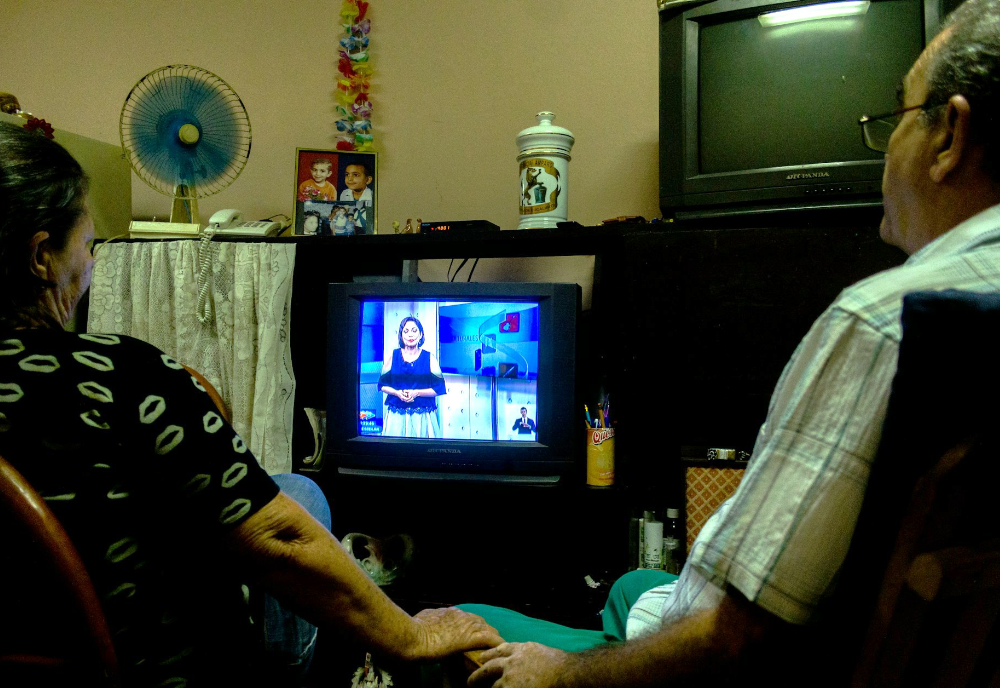
Photo by Ricardo IV Tamayo on Unsplash.