
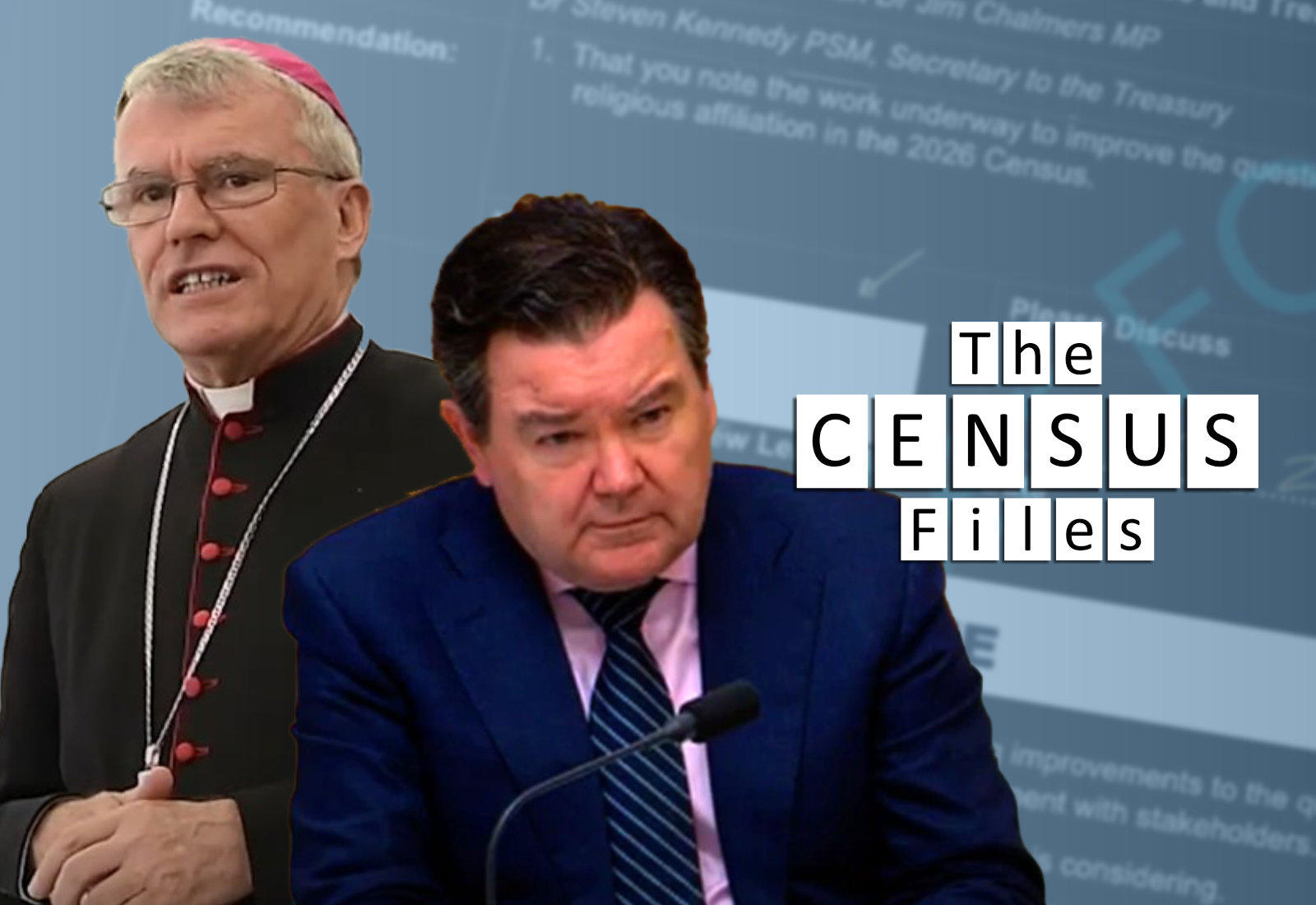
This article is Part 1 in our ‘The Census Files’ series.
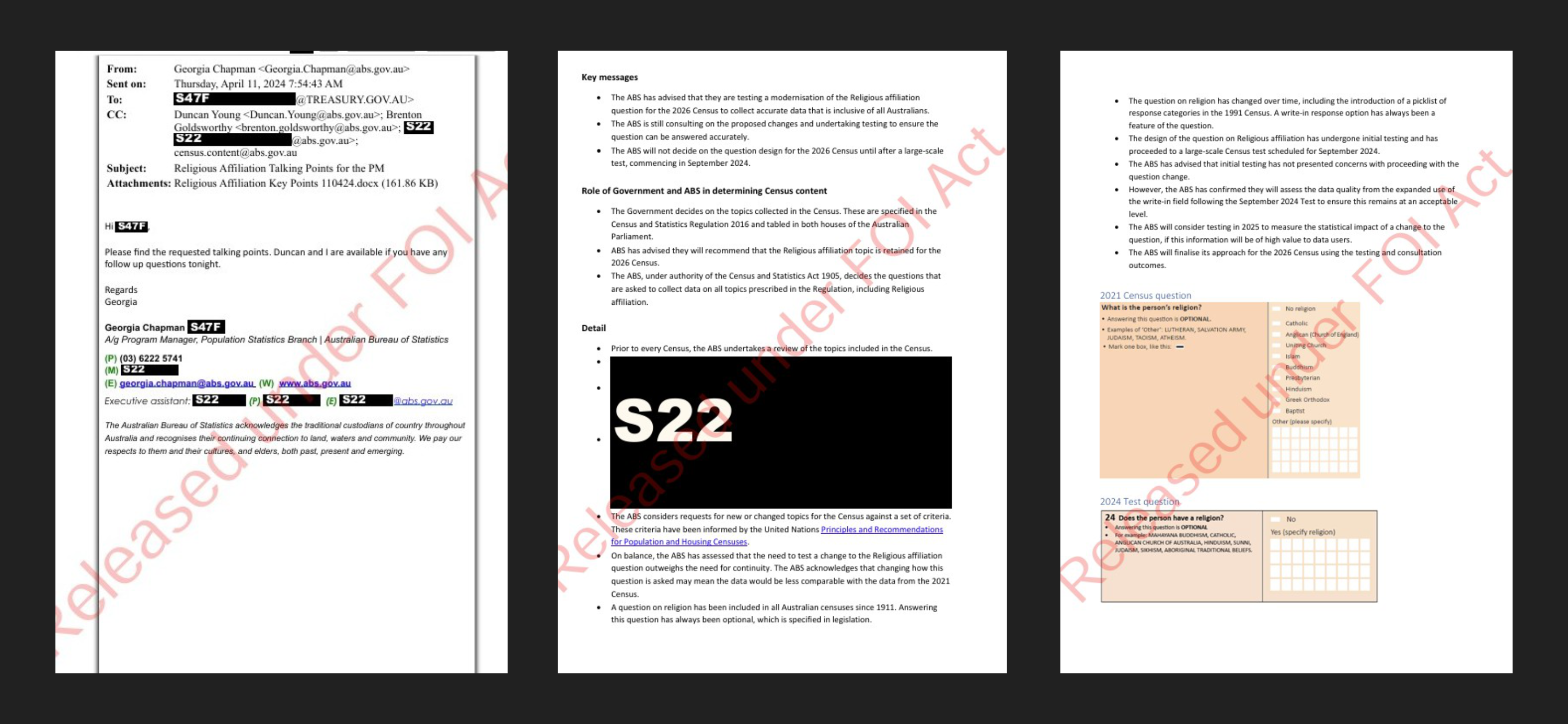
On 11 April 2024, the Australian Bureau of Statistics (ABS) sent an email to a recipient in the federal Treasury Department with the subject line: “Religious Affiliation Talking Points for the PM”. “Please find the requested talking points,” wrote the Acting Program Manager of the Population Statistics Branch in the short email.
The email was among the hundreds of pages of documents obtained by the Rationalist Society of Australia under freedom of information (FOI) laws and revealing documentation of the ABS’ work, throughout 2024, on a proposed new religion question for the 2026 Census, and revealing correspondence between ABS executives, government ministers and departments, and religious community groups.
While it was not clear whether the ‘PM’ in the subject line was referring to Prime Minister Anthony Albanese, the request for talking points by the Treasury’s Department, regarding one topic from a Census to be held in more than two years’ time, suggests strong interest in the matter at the highest levels of the federal government.
The government’s need for information about the ABS’ work on the religion question became evident within days of the email to the Treasury Department, as a powerful special interest group, the Catholic Church, launched a public campaign calling for the government to intervene.
The FOI documents show that, in the early months of 2024, the ABS was continuing with cognitive testing for the suite of topics and questions that it was preparing to take to the critical large-scale test in September that year (also referred to here as the ‘Census Test’). As part of that test, the ABS planned to send a Census form with all the proposed questions to thousands of households, reaching up to about 50,000 respondents. The test was viewed as critical to providing the ABS with the information it needed about the performance of new topics that it proposed to ask at the 2026 Census, and of a number of newly formulated questions for existing topics.
In a public statement in December 2023, the ABS, following an extensive public consultation process, announced it had shortlisted for further testing and development five new topics, plus modifications to the questions used for 12 existing topics. Among these was a newly reformulated question, removing the biased wording and removing the picklist, for the topic of religious affiliation.
As part of its process, the ABS expected to make a recommendation to the federal government by mid 2024 on the topics to be used for the 2026 Census. According to the timelines, the government was then expected to confirm the topics by the end of July/early August, giving the ABS enough time to prepare for the critical Census Test.
It is critical to note the roles of government and the ABS in determining the content of the Census. The ABS’ website says:
The topics that can be collected in the Census are specified in the Census and Statistics Regulation 2016 (the Regulation). The Australian Government makes the decision on what topics are included in the Regulation. The ABS has the authority to determine the wording of the questions for the topics in the Census.
In other words, while the government has a say over whether the topic of religious affiliation is to be included in the Census, the ABS is supposed to have the final say on how it asks the question for that topic. And, in the first half of 2024, the ABS was going full-steam ahead with its plan to change the religion question.
In the talking points attached to the email to the Treasury Department in April 2024, the ABS said that it would be recommending the religious affiliation topic remain in the Census but that it would be “testing a modernisation of the Religious affiliation question for the 2026 Census to collect accurate data that is inclusive of all Australians”.
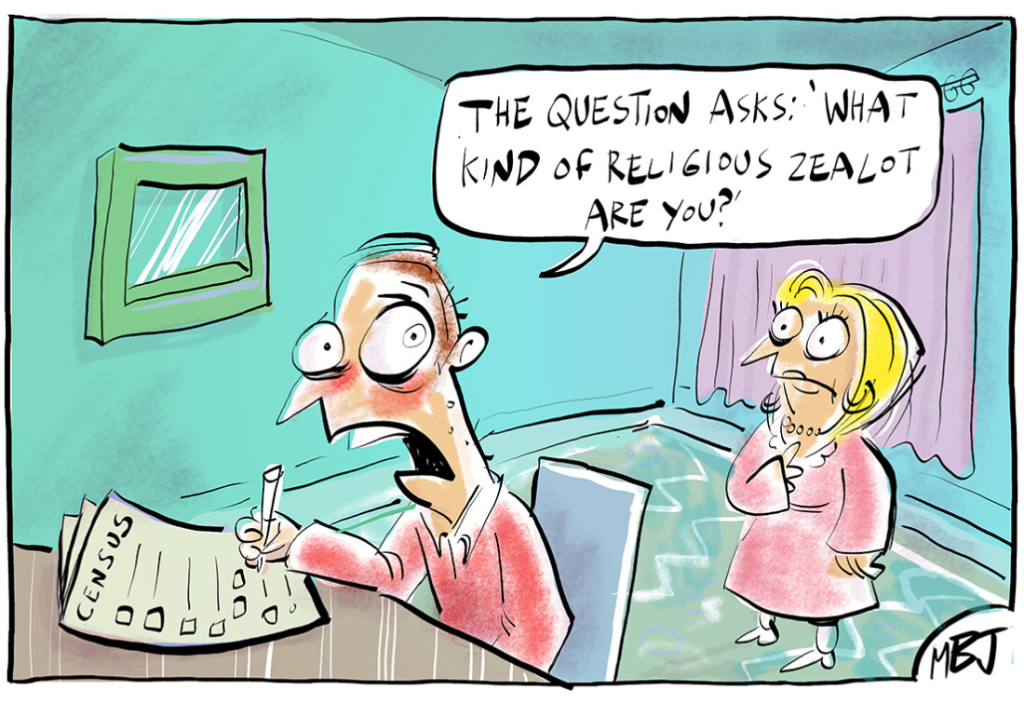
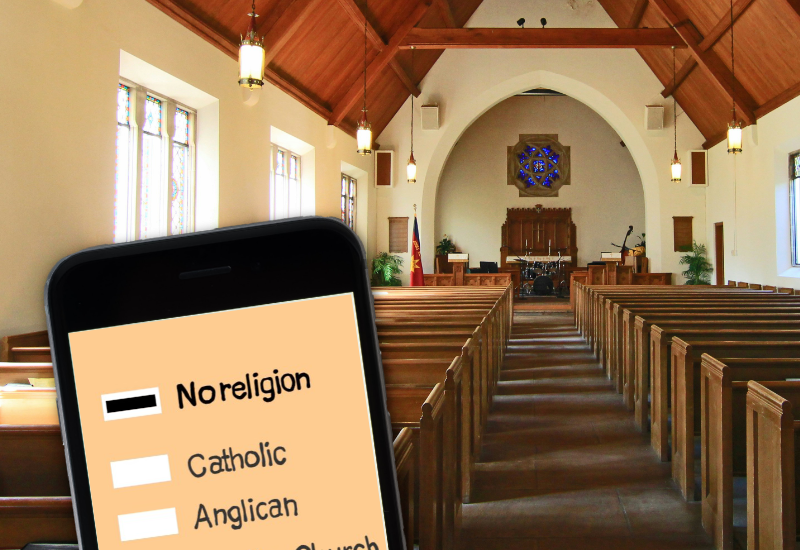
Following two large-scale public consultations and initial rounds of cognitive testing, the ABS had decided to change the wording of the question to remove the inherent bias that presumed all respondents have a religion. Instead of again using, ‘What is the person’s religion?’, accompanied by a picklist of the most common religions and a ‘No religion’ box at the top of that list, the ABS was proposing to ask, ‘Does the person have a religion?’. Under the proposed change, respondents would then be presented with ‘Yes’ and ‘No’ boxes, and a free-text box for those who affirmed a religious affiliation to write their denomination.
During the two-year consultation process, the Australian public had raised the problem of the bias in the existing religion question and how it produced flawed data and inflated results in favour of religion. It was the topic that received the most public submissions, with the need for change overwhelmingly supported.
In July 2023, following phase 1 of the consultation, the ABS publicly acknowledged on its website the public’s concern that the question “assumes you have a religion”. Later, following phase 2 of the consultation process, the ABS announced the proposed changes to the question design – including the changed wording of the question – in order to “support more accurate data collection”.
In the talking points sent to the Treasury Department in April 2024, the ABS reported that initial testing of the reformulated question had “not presented concerns with proceeding with the question change”. The newly worded question was, therefore, well and truly on the way for inclusion in the 2024 Census Test later in the year. In the document, the ABS also reminded the government that it was the ABS’ job to decide how the question would be asked in the 2026 Census.
Just weeks earlier, in March, the ABS shared email correspondence with some of the country’s most powerful religious organisations, notifying them of the proposed changes to the design of the religion question. In an email to the Australian Catholic Bishops’ Conference, the ABS explained that the new religion question would “proceed to the large-scale test” in September 2024 and that decisions on the final questions to be used for the 2026 Census would then follow.
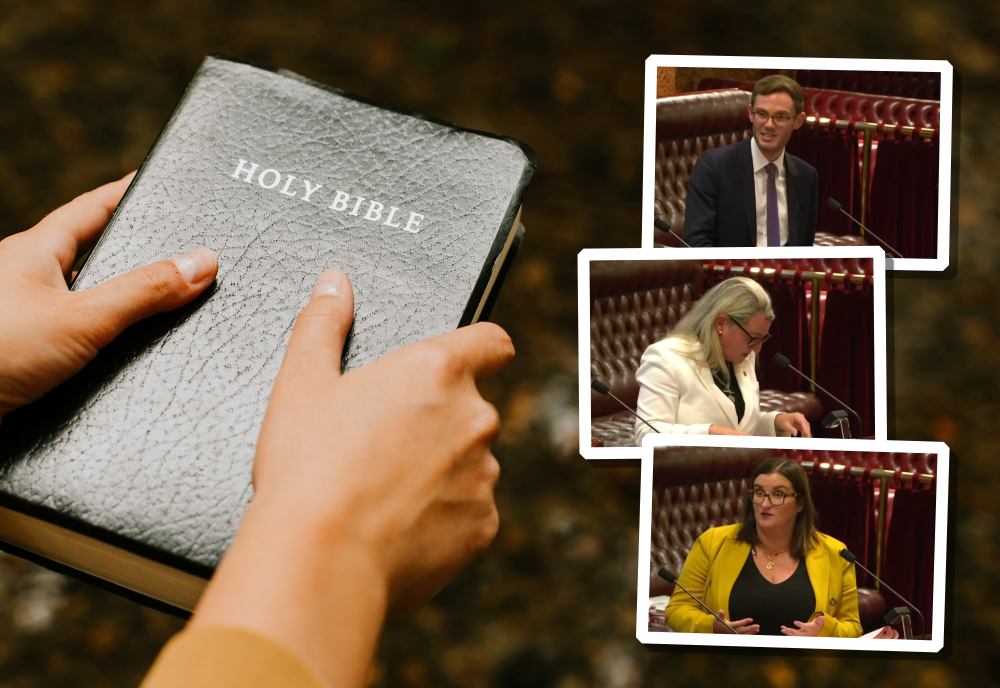
In late April, it became clear that the Catholic bishops were not happy with the changes being proposed to the religion question. In an opinion piece in The Australian, Perth Archbishop Timothy Costelloe (pictured) claimed that the ABS appeared to be “seeking to weaken the accuracy” of the religion question, and he called on the Albanese government to “reconsider its proposed changes”.
Costelloe was concerned that the proposed change to the question would “disengage religion from culture”, arguing that the existing question assessed religious identification as part of a person’s culture and heritage. Changing the question, he said, would also affect the ability of the church and other users to compare data over time.
Erroneously, Costelloe claimed that the new question would not provide a ‘Yes’ tick box while it would provide a tick box for ‘No’, and would thus create a “new bias” in favour of ‘no religion’. This was not what the ABS was proposing.
Costelloe also argued that people from ethnic backgrounds or with poor literacy and language skills would face challenges in writing their religious affiliation into the free-text box.
More archbishops and other Catholic figures picked up the baton, echoing Costelloe’s arguments. Church figures took their concerns directly to the top of the federal government. On 1 May 2024, the Catholic Weekly reported that, since “discovering” the proposed change to the religion question in March, “some Catholic Church leaders have already written to Prime Minister Anthony Albanese”.
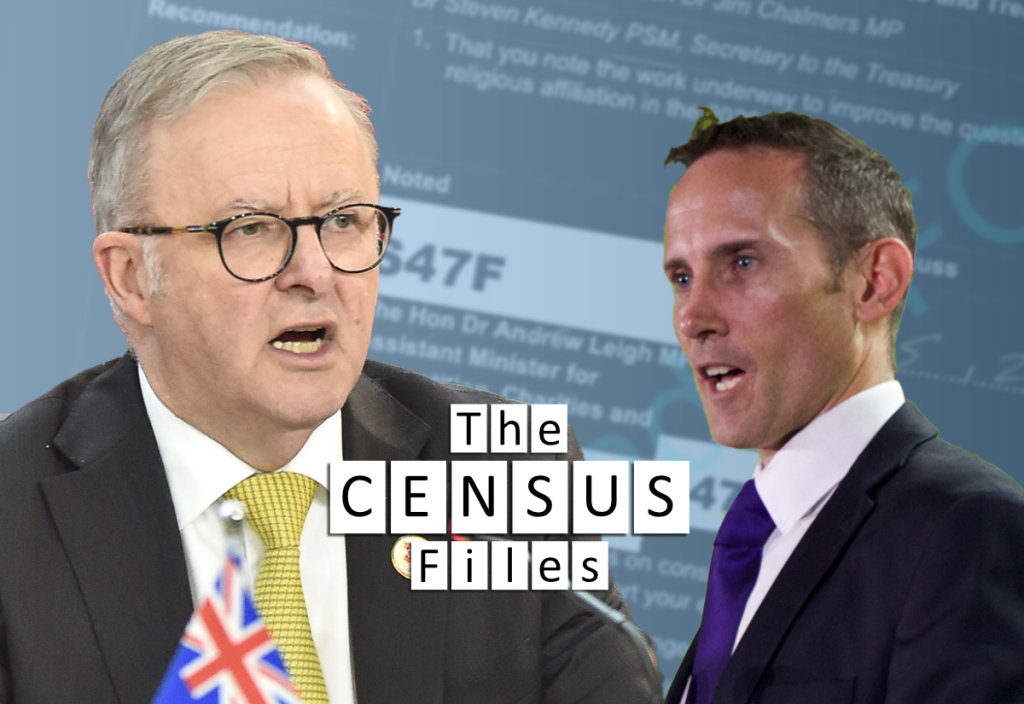
In response, the ABS issued a public clarification to counter the claims made in media reports. Privately, in a briefing document sent to the responsible minister, Andrew Leigh, on 3 May 2024, and with Treasurer Jim Chalmers in CC, the ABS also addressed the “inaccuracies” of the media reports. In this document – in which Dr Leigh noted the ABS’s statement on “the work underway to improve the question on religious affiliation in the 2026 Census” – the ABS explained the need for the change to the question:
The ABS has determined that updates are required to the way religious affiliation data is collected in the Census to better reflect the diversity of the Australian community and address concerns regarding quality of data with the existing question.
The changes being considered and tested by the ABS look to remove the assumption that a person has a religion, and also to treat equally the 139 religious groups in the classification by not having a picklist for the 9 most common religions.
…the ABS is of the view that the question ‘What is the person’s religion?’ contains an assumption that the person has a religion and makes the answer “No religion” grammatically incorrect.” The question “Does the person have a religion?” is thought to be a better question with two options for response: “No”, and “Yes” (specify religion)”. Other questions follow this design – for example, the question is “Does the person use a language other than English at home?” not “What language other than English does the person use at home?
In the same document, the ABS summarised the concerns raised by religious groups about the proposed changes as follows:
…that the data will not be comparable between Censuses, that the question concept is being changed in undesirable ways, and/or that the question will be harder for people to complete and reduce data quality, particularly for minor religious groups.
But then the ABS comprehensively rejected these concerns. On the concern about comparability with past Censuses, the ABS told the ministers:
While maintaining consistency in questions to support comparability over time is a consideration for the ABS, this is balanced against changes to improve accuracy, relevance and inclusivity.
The religious affiliation question has undergone five major changes since 1911: including instructions that question was optional (1933); including instructions that a person could report they had no religion (1971); introducing a pick list (1991), changing from religious denomination to religion (2001) and moving the ‘no religion’ option to the first mark box (2016).
A case could have been made against each of these changes about the impact on data comparability.
Addressing the concern that some people would experience difficulty writing their religion in the free text box, the ABS said:
People have always been able to write in their response to answer the question. In 2021, 2.5 million responses (over 10% of respondents) were reported via write-in.
The statement that the inability for people to enter perfect data in a free text box will lead to poor data is not necessarily correct. The Census has many free text boxes and advanced coding processes that successfully classify responses against a classification. This is the process for the majority of religious groups currently.
The FOI documents also reveal that the ABS was justified in its confidence in forging ahead with the reformulated question for the major test in September. In March 2024, an ‘executive brief’ stated that, after five rounds of cognitive interviewing, the question ‘Does the person have a religion?’ (with ‘No’ and ‘Yes’ responses, plus an open text box) was “the most successful question” and had “tested sufficiently”.
In late February, a senior executive had noted “we haven’t seen any issues with people feeling its [sic] more of a burden, but we haven’t been able to test at scale with large households…”. They added that the question design could be reverted to the old one following the 2024 Census Test “if we absolutely need”.
Once the Catholic hierarchy had spoken out about the proposed change, Liberal Party figures joined the pushback against the proposed new question. The Australian reported that former Prime Minister John Howard accused the public service of being pitted against religion, saying: “You’ve got to worry that the anti-religious lobby in the public service is quite strong.”
The FOI documents show that Liberal Senator for Western Australia Dean Smith (pictured) – the coalition’s spokesperson for ABS matters – sought a meeting with the ABS in early May, just days after the initial reports in The Australian.
An internal email from an ABS executive following the subsequent meeting explained that Senator Smith said he had been contacted by several parliamentarians following articles in The Australian about the bishops’ concerns. The ABS executive also noted that Senator Smith had wanted clarification on whether Catholics and Anglicans were being disadvantaged or would be most disadvantaged by the redesign of the religion question.
In a slide presentation prepared for Senator Smith, the ABS made comments about the existing question to highlight the problems that had been identified:
Does this assume that a person has a religion? Other questions ask ‘Does the person use a language other than English at home?’ not ‘What language other than English does the person use at home?’
At a Senate Estimates hearing the following month, Senator Smith followed up with questions of the head of the ABS, Australian Statistician David Gruen, and raised what he described as the “very sensitive” and “increasingly contentious matter” of the religious affiliation question.
In response, Dr Gruen explained that the ABS would test the proposed new question in the 2024 Census Test in September and that, for the meantime, he was committed to meeting with religious stakeholders as part of a “listening phase”. Dr Gruen added:
A decision will be made later in the year on the basis of the evidence that we get from the test and from consultations that we have with religious groups… It won’t simply be the results of the test which will matter; I’m also very happy to have representations from religious groups, if they wish to meet us…
Dr Gruen also made it clear to the Senate that, ultimately, he would be the one to decide the question to be used at the 2026 Census.
Within the ABS, confirmation that the newly formulated religion question would be included in the 2024 Census Test came on 10 May. Brenton Goldsworthy, Deputy Australian Statistician, approved the proposed ‘package of change’ which had been outlined in an executive brief titled ‘2026 Census Topic Review: 2024 Major Census Test Decision Point’. This document identified the driver for change to the religious affiliation question as “Data quality and inclusivity”, adding that the update of question design was to “support more accurate data collection”.
The executive brief explained the process of refinement that the new question had undergone over five rounds of cognitive testing and said it had “tested sufficiently”:
Those with a strong connection to religion, or who do not have a religion, have found the question straightforward to answer. Those who have a belief system that does not align with a specific religious group, or who have lower literacy levels, found the question harder to answer.
The document also asked Mr Goldsworthy to note that the “decision on the package of change proceeding to the 2024 Major Census test” was separate to the government’s decision on “topic recommendations or question design for the 2026 Census”. Regarding the religion question, however, the document identified it as a “planned content enhancement” that “would not require Government approval”.
Whether in statements to the Senate, in briefs to government ministers or internally, that ABS was clear on the critical nature of the planned 2024 Census Test in obtaining the data it needed to inform its decision on whether to adopt the new religion question. This was also the case in the executive brief to Mr Goldsworthy in May:
The 2024 Test is a critical activity as it provides the last opportunity to test the Census questions and the Census questionnaire before print deadlines. This allows the ABS to confirm the new questions and other content changes to collect data of the expected quality, or to guide further refinement to questions and their placement on the form.
But, given the promise of Dr Gruen to hold further consultations in response to political pressure and the media campaign by Catholic bishops, the results of the test would now be balanced with feedback from the engagement with public stakeholders – mainly religious groups – over the ensuing months.
In regards to this new consultation phase, a document detailing ‘Outcome of mid-point review’ of ‘Phase two topic assessments’ and signed off in May 2024 said:
…the ABS should engage with peak organisations to confirm all potential impacts are fully understood and analysis of the 2024 Census Test data will be needed to understand impacts in larger households and at scale.
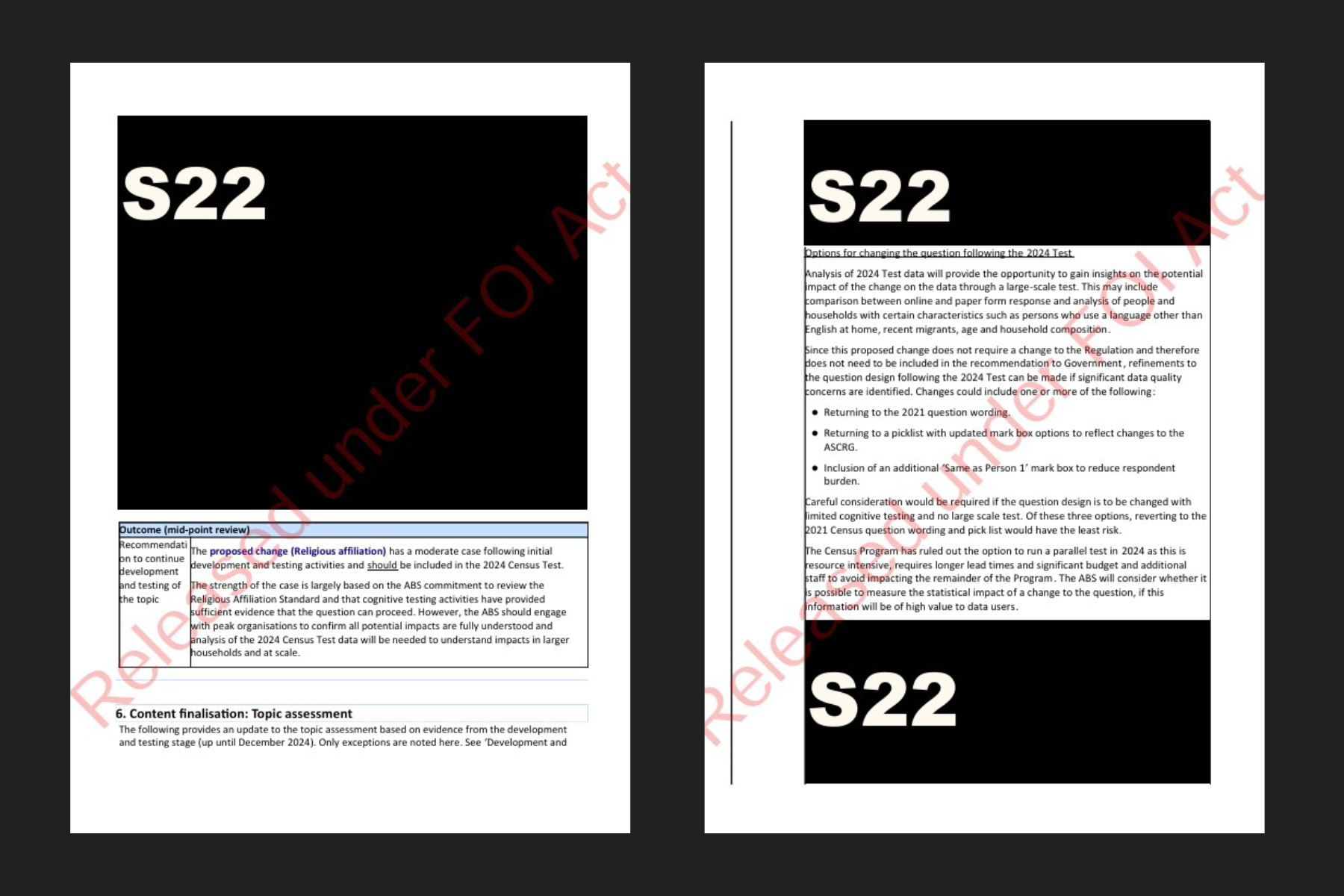
That same document listed returning to the 2021 Census question – the biased question, ‘What is the person’s religion?’ – as an option for the 2026 Census should the 2024 Census Test raise “significant data quality concerns” about the reformulated question, or in the event the major test was not conducted. It continued:
Careful consideration would be required if the question design is to be changed with limited cognitive testing and no large scale test. Of these three options, reverting to the 2021 Census question wording and pick list would have the least risk.
At the onset of the winter months, the ABS was well down the path to taking its proposed new religion question to the 2024 Census Test in the spring and to delivering on its new commitment of consulting religious stakeholders.
But soon the ABS and the Census would be catapulted into the headlines. And, ultimately, everything would change.
Read Part 2 of the ‘The Census Files’ series.
Published 24 January 2026.
If you wish to republish this original article, please attribute to Rationale. Click here to find out more about republishing under Creative Commons.