

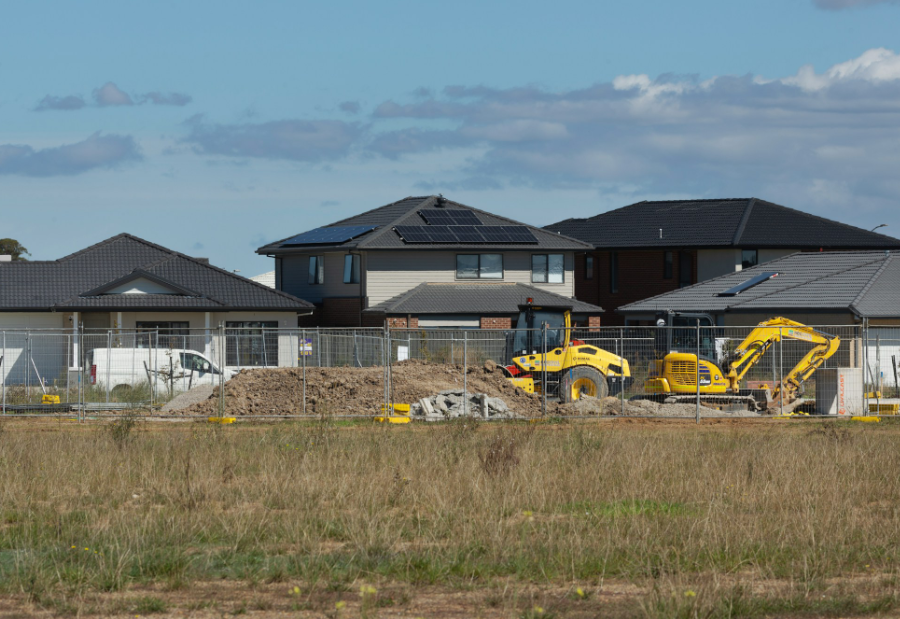
The policy in the federal budget to remove negative gearing and the 50 per cent reduction in capital gains tax after an asset is held for more than a year is a move to start reducing the massive distortion at the heart of Australia’s financial system. This distortion has split the society between older people, who bought homes when they were comparatively cheap, and younger people, who are either burdened with lifetime debt or cannot afford to be home owners.
It will not happen quickly and may be reversed if the coalition gets into power. But, given that about a year ago Australian property reached valuation levels comparable to the peak of Japan’s 1989 property bubble (relative to GDP), it was hard to avoid the conclusion that something had to be done.
Japan’s excesses in the late 1980s went down in folklore as the most ridiculous ever seen. It was claimed at the time that the land around the Emperor’s Imperial Palace was worth more than the state of California. Australia has now surpassed that level. Hopefully Australia will not have an economic crash like the one that has kept Japan in permanent recession for 35 years.
Australia’s excesses are the local version of a problem plaguing Western economies. In different ways, they are all locked inside a prison of usury: money with an interest rate on it. As the historian Michael Hudson has documented, for thousands of years financial systems based on debt have failed because, as the interest payments compound, they outpace real economic activity. That is why, as far back as Babylonian times, there have been debt holidays, cancellations and resets.
Those kinds of large-scale defaults are not possible in modern private banking systems. China can do them because the government owns the banks.
So what has happened instead is that, as the debt reached levels that are unpayable central banks created ‘liquidity’ (printed money) to keep the markets going and convinced the traders that there is enough money in the system to avoid collapse.
That process kicked off after the financial crisis of 2008 when the official government bailout in the US was $US700 billion, but the Federal Reserve injected an eye watering $US29 trillion into the system to stop it collapsing. The practice has continued since.
This is the context in which Australia’s bank-driven property bubble has occurred. Australia’s government debt is only about half the OECD average because government debt was all but removed entirely in 2006/07 because of the mining boom. But household debt is an outrageous 112 per cent of GDP, leaving about a third of the population with large mortgages hanging on every decision the Reserve Bank makes about interest rates.
In the public sphere, there is no mention of the real culprit for the excesses: the banks. That suggests there is almost complete ignorance of the causes of what is happening, there is only a knowledge of the effects.
It has not been a supply-demand problem, nor the result of high immigration. Neither explain the extent of the bubble. Property developers are also blamed. They do have a disproportionate effect on state governments, and they have manipulated the supply of land. But the idea that there is a shortage of land in Australia does not pass the laugh test. Australia is the fourth least populous nation on earth after Greenland, Mongolia and Namibia.
Rather, it has been the banks’ willingness to lend, especially to investors, that has driven up prices, financialised the whole country and turned a fifth of the population into property gamblers. The banks were unleashed by the so-called financial deregulation of the 1980s and they have got an ever tightening grip.
… it was hard to avoid the conclusion that something had to be done.
With the attractiveness of property investment set to weaken because of the government’s changes, bank profits are likely to slow. After all, the reason the banks are so willing to lend is the bigger the mortgage the more money they make. That is perhaps why the coalition has adopted the opposite approach. They may have an eye to the party’s relationship to the Big Four banks, which have a lot of financial and political clout.
Negative gearing investors have been a huge customer base for the banks. Over a fifth of all residential dwellings in Australia are held by property investors, equating to over 2.2 million houses. About a fifth of taxpayers own at least one investment property and they have been receiving about a third of total housing finance. It has become the nation’s favourite financial pastime.
For the purists, removing negative gearing is an unjustified move because, as a general principle, interest costs in, say, a business can be used to reduce tax liability. But, for anyone who lives in the real world in Australia, it should have been obvious that it is the main reason we have a property bubble and it had to be brought under control at some point.
The move changes where Australia is on the negative gearing spectrum amongst developed nations. Germany, Japan, Canada and Norway all have similar approaches to Australia’s old policy. Other countries, including the US, have less generous policies, and the United Kingdom has abolished it entirely. The country closest to Australia is Canada, and its household debt is 130 per cent of GDP.
But countering the grip of usury and the financialisation of Australia – the socially destructive practice of making money out of money in a continuous spiral – will require a lot more. Historically, the best way is to put industrial production first and money second, an approach called American Political Economy, which neither aligns with the Left-wing emphasis on government spending (Keynesianism) nor the Right-wing concentration on controlling the money supply and inflation (monetarism).

This approach says that production is real and money is just an artificial creation that should serve society, not be ruled by it. That is the usurious trap Australia has fallen into, as has much of the developed world. In modern capitalist economies about 98 per cent of the money in the system is in the form of credit – that is, it has an interest rate on it.
Australia’s real, productive economy has withered as the property bubble got bigger. Manufacturing as a proportion of Australia’s GDP has declined from a peak of around 13 per cent in the early 1990s to a historic low of approximately 5.4 per cent. It is no accident that this started shortly after financial ‘deregulation’.
The same pattern is evident in the nation’s oldest industry. Since 2002, the volume of Australia’s agricultural production per head has dropped a disastrous 31 per cent. If the trend continues, output is set to fall to half by 2040. Agricultural imports have been rising faster than Australia’s agricultural exports for over three decades. On the current trajectory, Australia will become a net importer of agriculture by 2037.
Improving primary and secondary industry is just as important as removing the financial distortions. Yet, there is little evidence that Canberra’s political class is even aware of the problem.
Published 22 May 2026.
If you wish to republish this original article, please attribute to Rationale. Click here to find out more about republishing under Creative Commons.
Photo by Troy Mortier on Unsplash.