
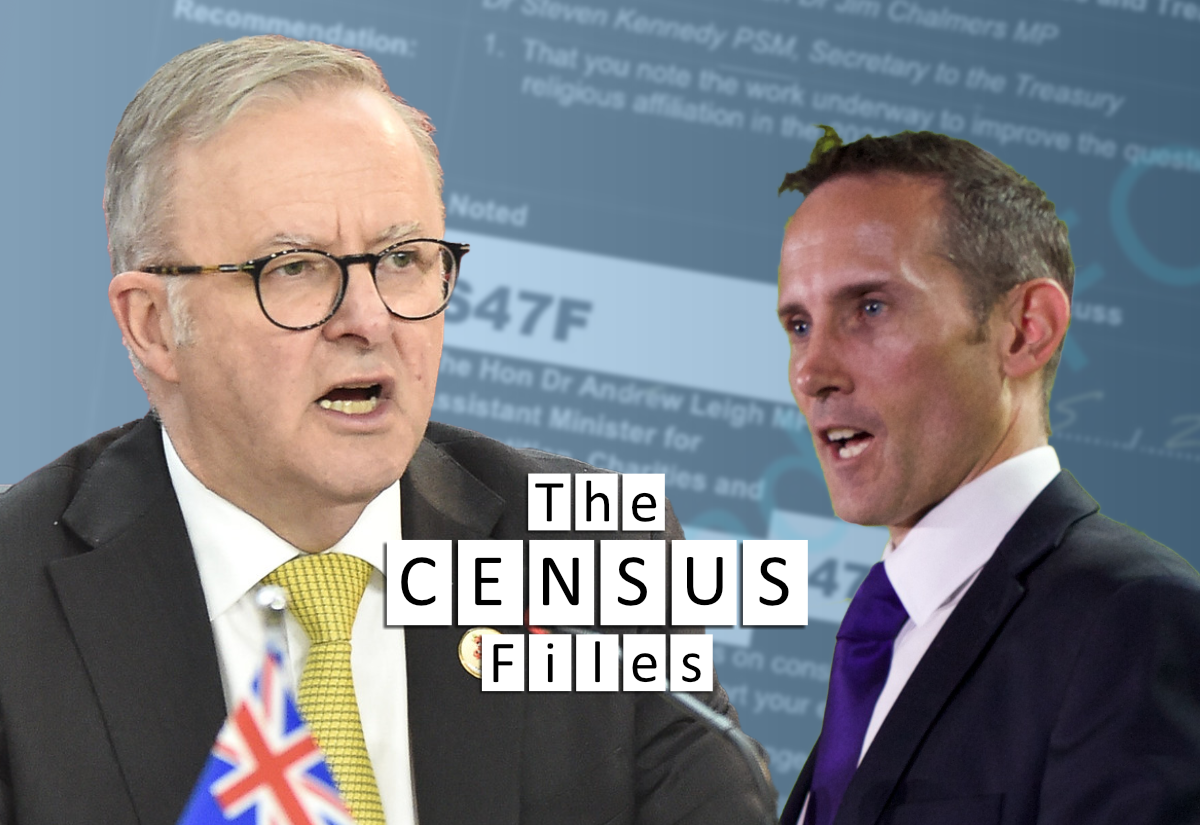
This is Part 2 in our ‘The Census Files’ series. Read Part 1 here.
Throughout the winter months of 2024, executives at the Australia Bureau of Statistics – and, on occasion, the head of agency, David Gruen – met with representatives of all kinds of religious groups and religious lobbyists to discuss the proposed changes to the Census religion question.
Documents obtained by the Rationalist Society of Australia under Freedom of Information (FOI) laws reveal the notes taken by the ABS of such meetings, including its joint meeting with representatives of the Australian Catholic Bishops Conference (ACBC) and the Anglican Church of Australia (ACA) on 9 August.
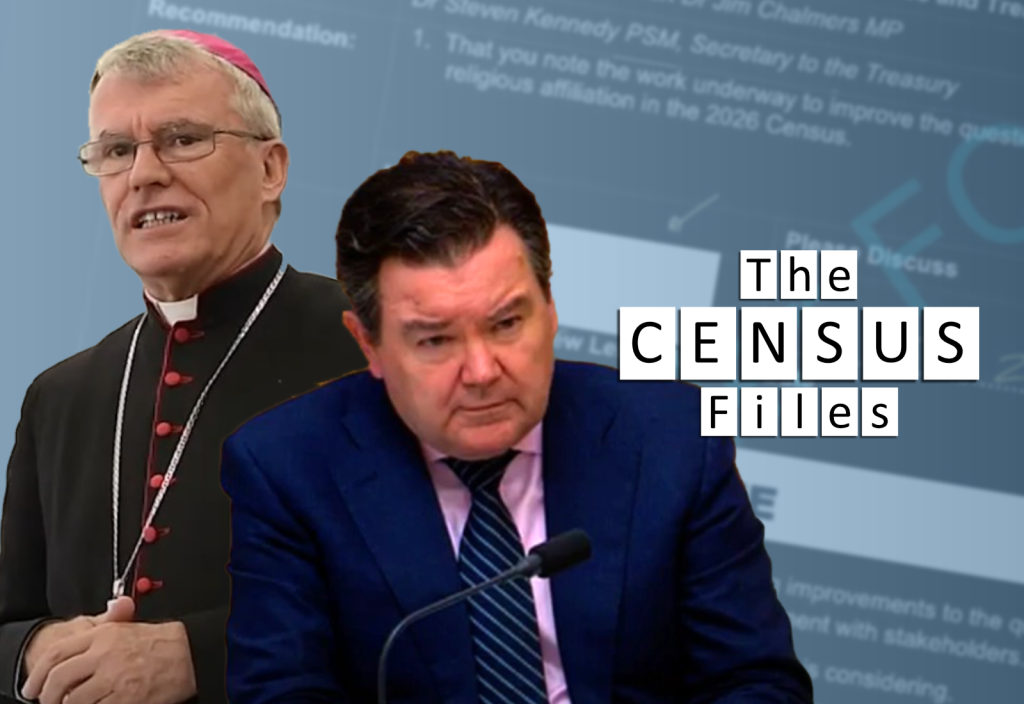
Among those in attendance from the ACBC was Perth Archbishop Timothy Costello, who, earlier that year, led the church’s push for the Albanese government to intervene and put a stop to any changes to the religion question.
In the meeting, church representatives “expressed concern” that the proposed new religious question for the Census would discourage respondents from reporting an affiliation if they were not practising. They also worried that removal of the picklist would add to the burden on people reporting a religious affiliation, and that culturally diverse people would face greater difficulty in completing the free-text box.
According to the notes, the ABS agreed to keep both the ACBC and ACA informed about the outcomes of the 2024 Census Test – the critical major test that was due to be held in September and that would provide the data and information that the ABS needed to decide whether it would go ahead with adopting a reformulated religion question, with the biased removed, for the 2026 Census.
Notes from other meetings with religious lobbyists around the same time show that Hindu Council of Australia was “extremely worried” that 40 per cent of Australians had “voted no religion” at the previous Census in 2021. Meanwhile, the Australian Christian Lobby’s Michelle Pearse argued that, without the pick list, the “extra steps” for people from the top religious affiliations would have a “higher level of user burden”.
In a meeting on 19 June 2024, the Executive Council of Australian Jewry (ECAJ) argued that the ABS should prioritise the views of religious organisations that use the data for their planning instead of the views of non-religious organisations and individuals who “don’t need the data for their planning and want to focus on accuracy over the need for comparability” with past censuses.
According to the meeting notes, the ECAJ was also clearly worried about the potential impact on its own results for Judaism, telling the ABS that a sizable proportion of the Jewish community “identify as Jewish in a cultural sense, but as secular in a religious sense”.
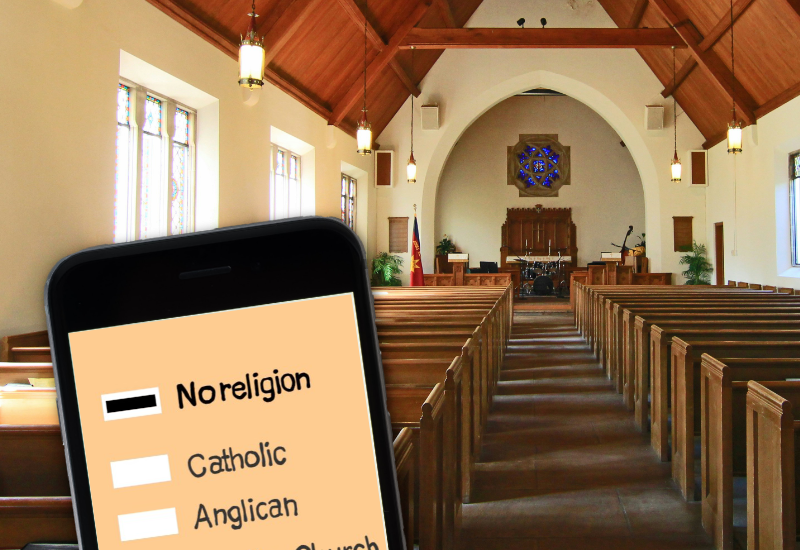
During these meetings, the ABS was consistent in communicating a couple of key messages: firstly, that the proposed reformulated question was locked in for the 2024 Census Test (see image below); and, secondly, a reminder that the government’s job was to decide the topics that would feature in the Census, while the ABS’ job was to decide how to best ask each question.
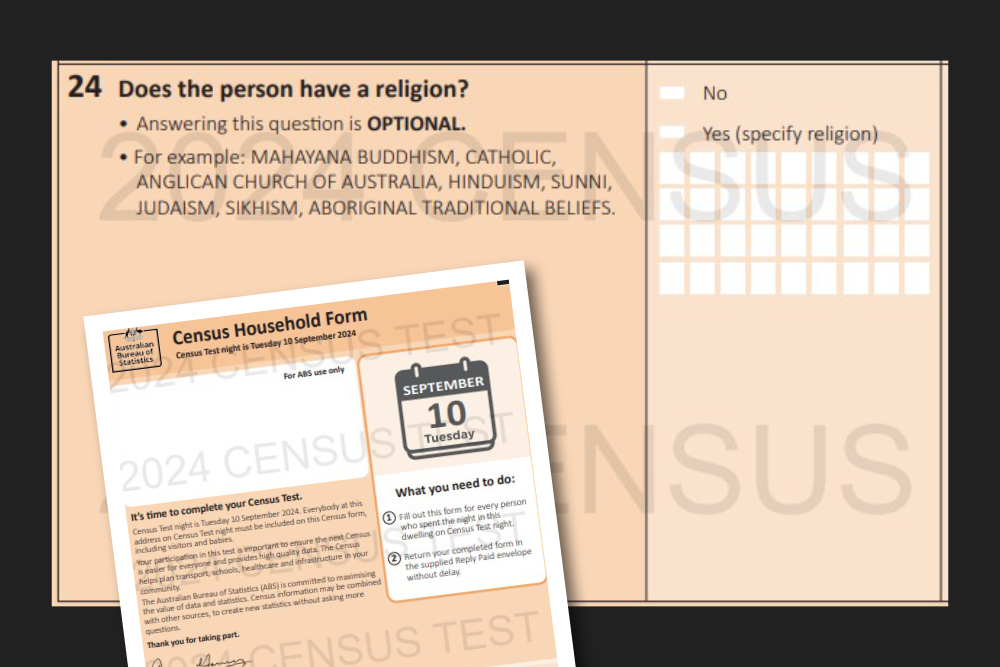
But before the Census Test could be conducted in September, the ABS’ process required the federal government to make its decision on the Census topics that it wanted to be included in the 2026 Census. The May 2024 executive brief titled ‘2026 Census Topic Review: 2024 Major Census Test Decision Point’ noted:
This timing was planned for and provided the ABS with sufficient time for consultation and testing to inform the recommendations, and sufficient time for Government decision and updating of the Census Regulation.
This document was also clear that the ABS viewed it as “important” to include in the Census Test “all Census topics … that may” appear in the 2026 Census, but added that their inclusion in the test did not amount to a commitment to, ultimately, recommending them to the government.
During this additional consultation period, the ABS advised another stakeholder that, beyond the 2024 Census Test, the process for finalising the Census questions would include the ABS making a decision on the exact wording and nature of the questions in late 2024 and then likely finalising them in late 2025 following further testing. The ABS expected to send the topics to the federal parliament for the mere formality of parliamentary approval in mid 2025.
Documents provided to the Australian Senate in September 2024, in response to an Order for the Production of Documents, reveal that repeated government delays on advising of the topics it wanted included in the 2026 Census squeezed the ABS’ timeline in the lead-up to the major Census Test, scheduled for September.
In mid 2024, the ABS reported to Assistant Minister Andrew Leigh that preparations for the Census Test were “on track”. The ABS had set Tuesday 10 September 2024 as the night for the test and had “onboarded” vendors for mail and printing services. It had also begun work with Dr Leigh’s office to develop a communications and engagement strategy for the announcement of the government’s decision on the topics.
In early July, the ABS provided Dr Leigh’s adviser, Nick Terrell, with a draft brief and draft letter for Prime Minister Albanese and Treasurer Chalmers in which Dr Leigh would seek the government’s decision on the Census topics.
At this time, the ABS also outlined, in a slideshow presentation, its concerns about how the timing of the looming federal election in 2025, combined with fewer sitting days in parliament, may impact the “critical pathway” through parliament in 2025. Any changes to the topics would need to be reflected in the Census and Statistics Regulation 2016, which would then have to pass through a disallowance period in both houses of the federal parliament. Concerned about the potential passage through parliament of the regulation in an election year, the ABS noted that the timeline required a government decision on the topics “by late July/early August 2024”.
On 15 July 2024, the ABS, in a ‘For action’ memo sent to Dr Leigh, and CC-ed to Dr Chalmers, said the ABS requested “urgent” action – in the form of Dr Leigh’s agreement to the recommended topic changes – and urged a government decision to be made in July.
As you were advised on 6 June 2024 … a Government decision on the proposed topics is needed in July 2024 to mitigate unacceptable risk to a successful 2026 Census. … You will need to write to the Prime Minister to seek authority to progress changes to the Census. … The ABS preference is for the Government’s intention for the 2026 Census topic changes to be made as early as possible.
On the next day, Dr Leigh agreed to the proposed topic changes. Then, in an undated letter, he wrote to Dr Chalmers seeking his “support to write to Mr Albanese on matters relating to the Census…” and specifically seeking “authority and approval” for the topics as proposed by the ABS.
By 25 July, still with no government decision, the ABS postponed the scheduled meeting of the LGBTIQ+ Expert Advisory Committee (EAC) and revealed to EAC members there was “uncertainty on the direction” and “we do not know” when the government would announce its direction on topics.
On 13 August, Dr Leigh gave “verbal advice” to Dr Gruen that the government had decided it wanted the 2026 Census to collect data on the same topics as the 2021 Census.
On 16 August, Dr Gruen sent an urgent ‘For action’ memo to Dr Leigh, seeking written confirmation of the decision and of the government’s announcement plans by 21 August – a deadline that would allow the ABS to then finalise preparations for the scheduled Census Test in September. The memo said:
2024 Census Test communications are required to start no later than 22 August 2024. … This includes a national media briefing, launch of the Census website and a publication providing an update on the topic changes that have not progressed to the Test. … From 27 August 2024, members of the public will receive Census test forms… The timing of the Census Test is fixed as printed material has been produced, temporary staff have been recruited, arrangements are in place with external suppliers and the timing has been publicly communicated. The ABS needs to proceed with the Test to avoid any unacceptable risks to Census delivery.
Two days after the deadline, Dr Leigh signed the memo on 23 August approving the ABS’ recommendation that he confirm the government’s decision that the Census in 2026 would collect data on the same topics as were used in 2021. Dr Leigh had taken a week to respond to Dr Gruen’s most recent urgent request for confirmation of the government’s decision. And it was 10 days since Dr Leigh advised Dr Gruen verbally on 13 August.
Two days after Dr Leigh signed the memo, at 9:02am on Sunday 25 August 2024 Dr Leigh’s adviser, Mr Terrell, emailed Dr Gruen to “make sure you’re aware” that Sky News had reported on the government’s decision to make no change to Census topics.
A number of media outlets were soon reporting that the government had “quietly dumped” a proposal to include new topics about gender identity, variations of sex characteristics or sexual orientation, with some even suggesting that other proposed changes, such as to the religion question, had been caught in the net.
The media attention focused on the outcry of the LGBTIQ+ community, given that the ABS in August 2023 had issued a statement of regret for the distress caused by leaving off topics of gender identity, variations of sex characteristics or sexual orientation.
In the ensuing days, as the public backlash grew, government ministers made ham-fisted attempts to explain the government’s decision to use the same topics as the 2021 Census. Deputy Prime Minister Richard Marles said the government had opted to take the existing set of topics to the 2026 Census to avoid “divisive” community debates. Amanda Rishworth said the new questions had been ditched because proposed questions for the new topics were “very complex”.
According to The Guardian, Dr Chalmers then “appeared to open the door” to revise the decision. And, by this time, a number of backbenchers were going public in calling for their own government to reverse track.
Following a week of backlash, Mr Albanese confirmed there would now be a question on sexuality in the Census. On 30 August, Mr Albanese told ABC radio that the government had not gone through the Census “line by line” and said it was for the ABS to decide the questions to be asked. At the same time, Mr Albanese said that the government had rejected “proposals for wide-ranging changes in the Census” because “we think that that’s not appropriate”.
Mr Albanese’s comments on the following day suggest his government was not just concerned about the proposed topics for gender identity, variations of sex characteristics or sexual orientation.
Nothing has changed. [The government has been] consistent about having a common approach to these issues. We want to make sure that everyone is valued, regardless of their gender, their race, their faith, their sexual orientation. We value every Australian, and we’ll work with the ABS. This is a Census in 2026. It is two years away…
On 31 August, the media reported that Mr Albanese had made a “captain’s call” on the Census topics and overruled Dr Leigh’s recommendations to support the ABS’ proposed topics. Nine Newspapers reported that a source close to the Prime Minister confirmed that Mr Albanese had “stepped in” because Dr Leigh “had not made clear to more senior cabinet colleagues that the statistics bureau planned to ask a sweeping series of questions he feared were inappropriate.”
While a topic on gender and sexual orientation was then reinstated into the proposed 2026 Census, the status of the reformulated religion question was unclear in the days following the government’s intervention.
Importantly, though, the announcement that the government wanted to keep the 2021 topics and subsequent backflip on the gender and sexual orientation topic should not have changed the equation for the religion question. Given the government’s instruction to the ABS to re-use the existing topics from 2021, the religion topic would have remained in the Census. Plus, the ABS still had responsibility for determining how that question, like all others questions, would be asked.
But the government’s delays in informing the ABS of its decision on the topics – coming two days after the given deadline of 21 August – had instant consequences for the major Census Test, which had been billed as the critical step that would provide the ABS with the information it needed on the performance of the new religion question. While the major test would have included only five changes to topics, it would have tested numerous modifications to questions for 12 existing topics – including the proposed new religion question.
One day after news of the government’s decision emerged via the media, and a week after the ABS’ desired launch of public communications about the Census Test, Dr Gruen announced that he had cancelled the test. In a statement on the ABS website, he said:
Given the Government’s announcement yesterday that topics will remain unchanged from 2021, I have made the decision that the upcoming Test will not proceed. The Test would have included topics that the Government has now decided will not be in the 2026 Census. The ABS will adjust testing plans in light of this announcement, in order to best prepare us for a successful Census …
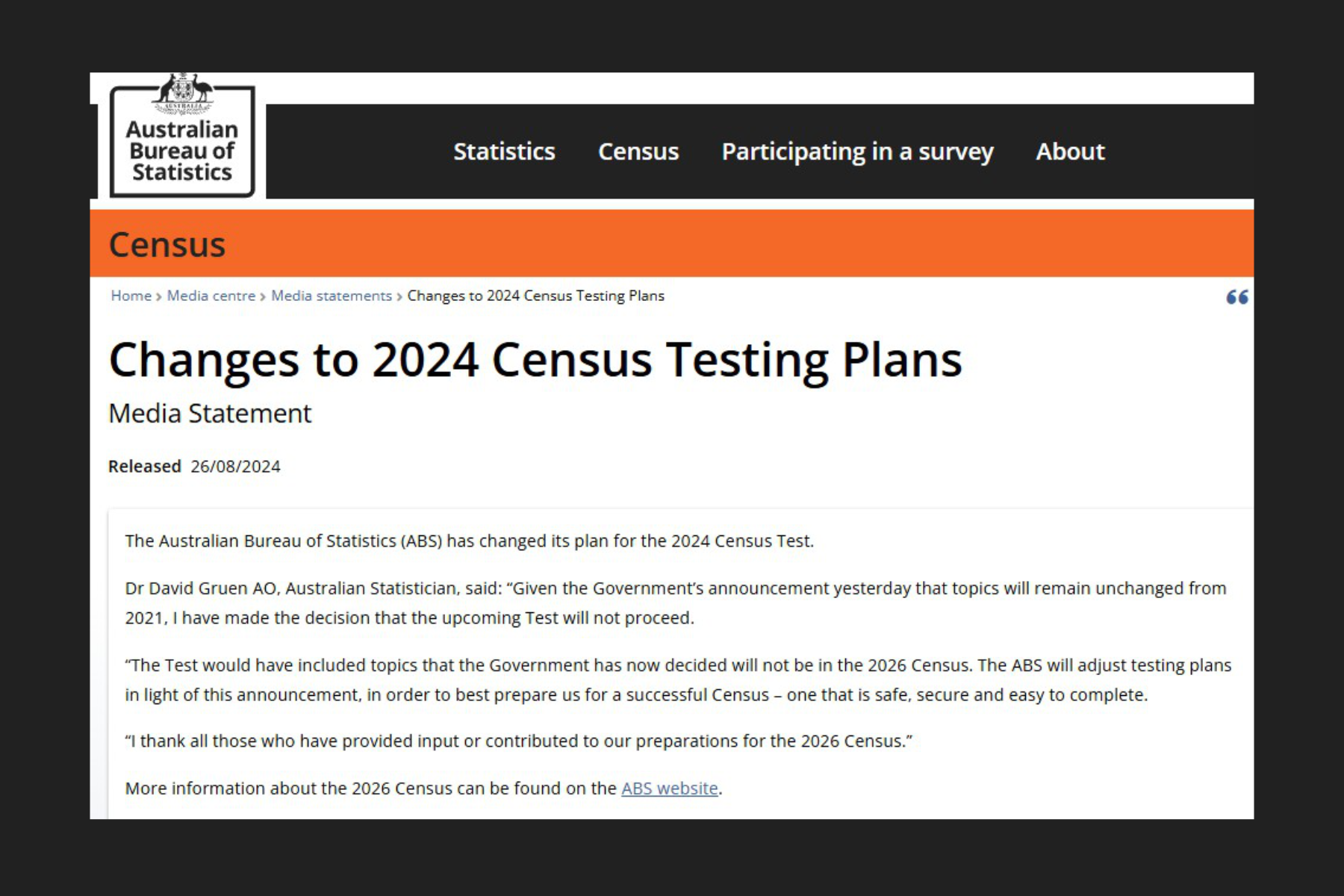
On 25 August, Dr Gruen signed off on an ‘Executive Brief – For Action’ memo approving the cancellation of the Census Test. The memo, since published on the ABS’ Freedom of Information disclosure log, had warned Dr Gruen of the possibility that the ABS would be criticised for the decision and also noted, in a discussion on ‘Risks and sensitivities’, the test’s importance to the religion question:
The ABS has communicated the value of this Test in relation to the testing of potential changes to the question on Religious affiliation. The ABS will need to rely on alternative testing methods and consider the available evidence in making a decision on how to finalise this question design.
Without the major Census Test, the ABS now faced a decision on whether to continue with the reformulated religion question without the information it needed about the question’s performance in a large-scale scenario. In May 2024, an ABS document said that, if no major test were conducted, “careful consideration” of the question design would be required. Reverting back to the 2021 Census question and pick list “would have the least risk”.
In email correspondence among ABS executives, concerns soon emerged about continuing with the new religion question without any data from the cancelled major test.
Published on 27 January 2026.
Editor’s note: The article was updated on 30 January to incorporate information about the 25 August memo relating to the cancellation of the Census Test.
If you wish to republish this original article, please attribute to Rationale. Click here to find out more about republishing under Creative Commons.
Image: Palácio do Planalto (Flickr, CC); Gavin Tapp (Flickr CC).