

This is Part 3 in our ‘The Census Files’ series. Read Part 1 here and Part 2 here.
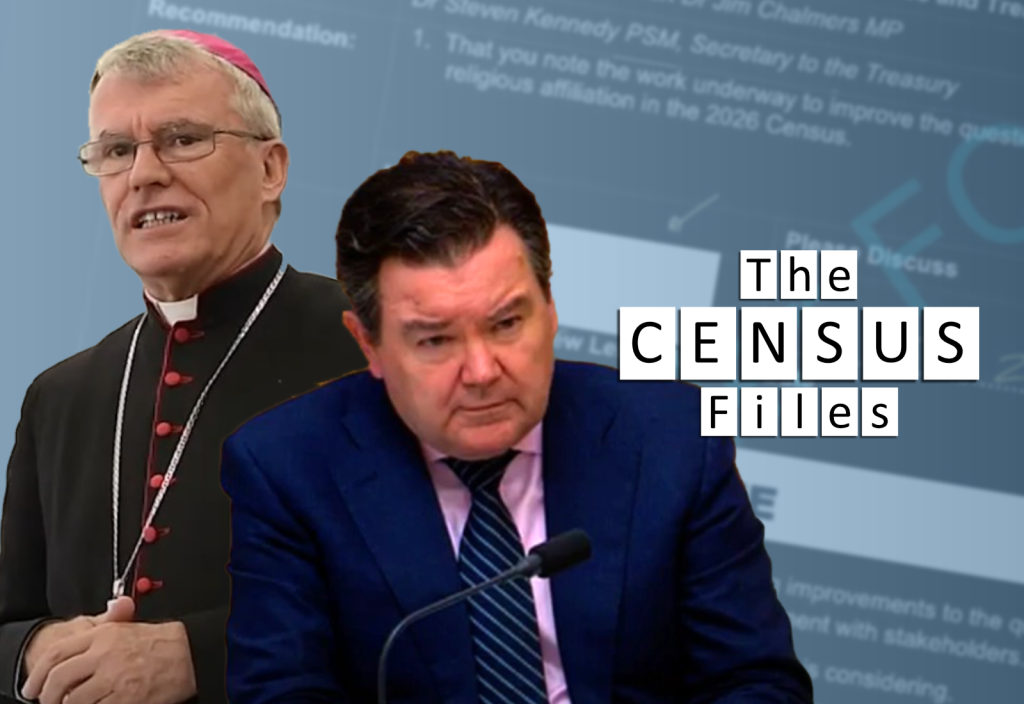
In early October 2024, the tide was turning against the new religion question as executives prepared for a meeting with the head of the ABS, David Gruen (pictured), to make a decision on the way forward.
Without any comprehensive quantitative data to measure the performance of the proposed religion question, due to the cancellation of the September Census Test, a number of ABS executives began raising concerns in email exchanges. Documents obtained by the Rationalist Society of Australia under freedom of information (FOI) laws reveal ABS executives discussing the risks of continuing with the proposed new question design.
Confusion also emerged at this time as to how the new question had been performing in recent rounds of cognitive testing – a methodology that deploys, typically, interviewing and surveying with individuals and smaller groups to understand their interpretation of questions, the burden of completing questions, and the usability of forms. Much of the concern among ABS executives surrounded the use of the free-text box which had, under the proposed question design, replaced the picklist of the most common religious affiliations.
The Director of Census Content Testing – whose name was redacted in the FOI documents – wrote:
The question is not performing well as it’s causing confusion over how broad or narrow the response should be, with respondents answering both broader and narrower than they would have with the 2021 question and response categories.
From the Director of Statistical Standards & Infrastructure (SSI) – whose name was also redacted – came the following:
… SSI has always supported the ‘free text for all’ option, however agree if we cannot thoroughly test any changes, then staying with the status quo is likely the least risky option.
With the decision taken not to undertake the September Test, the opportunity to more comprehensively test (ie beyond cognitive testing) the proposed change to the question wording, the risk of adverse statistical impact may be considered too great.
One executive said they were “interested to hear” that the question was not performing well.
… the last I had heard (before this recent round) was that the question was testing well.
Another executive – whose named was also redacted – chimed into the email discussion:
I hadn’t realised the text box question wasn’t performing well enough in the last two rounds [information redacted]. Agree this increases the risk for this design which I was already concerned about given the lack of field test.
The meeting with Dr Gruen was scheduled for 12 noon on 3 October 2024. By the evening of the previous day, it appeared that something of a consensus had formed among a number of the key decision-makers.
In an email, Denise Carlton, Program Manager of the Population Statistics Branch, said that this was a “complex one”, but was of the view that “in all my one-on-one discussions” with ‘AJ’ Lanyon and two other unnamed people “we’re all broadly all on the same page given the limitations/risks etc”. She added:
Where we land for 2026 will need to be a compromise for a range of reasons [information redacted].
A 12-slide presentation, prepared for the meeting, was titled ‘Religious affiliation question design: Considerations and options’. Slide 2 spelled out the objectives of the meeting as addressing ‘Key considerations for question design’ and discussing the direction for the religion question’s wording, for the response options, and for the instructional text and examples provided with the question.
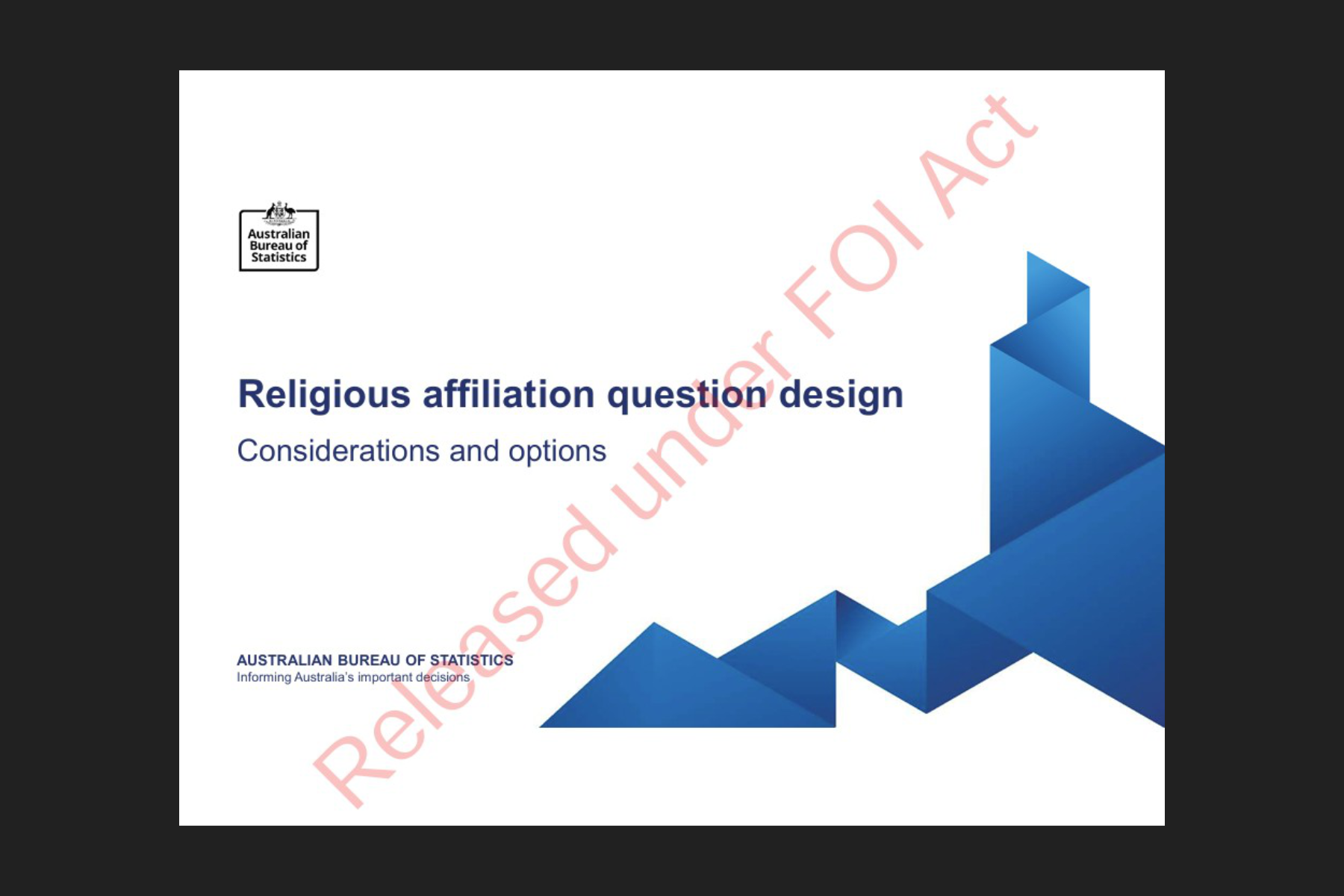
Three full slides of the presentation were redacted, as were a number of sections throughout the presentation.
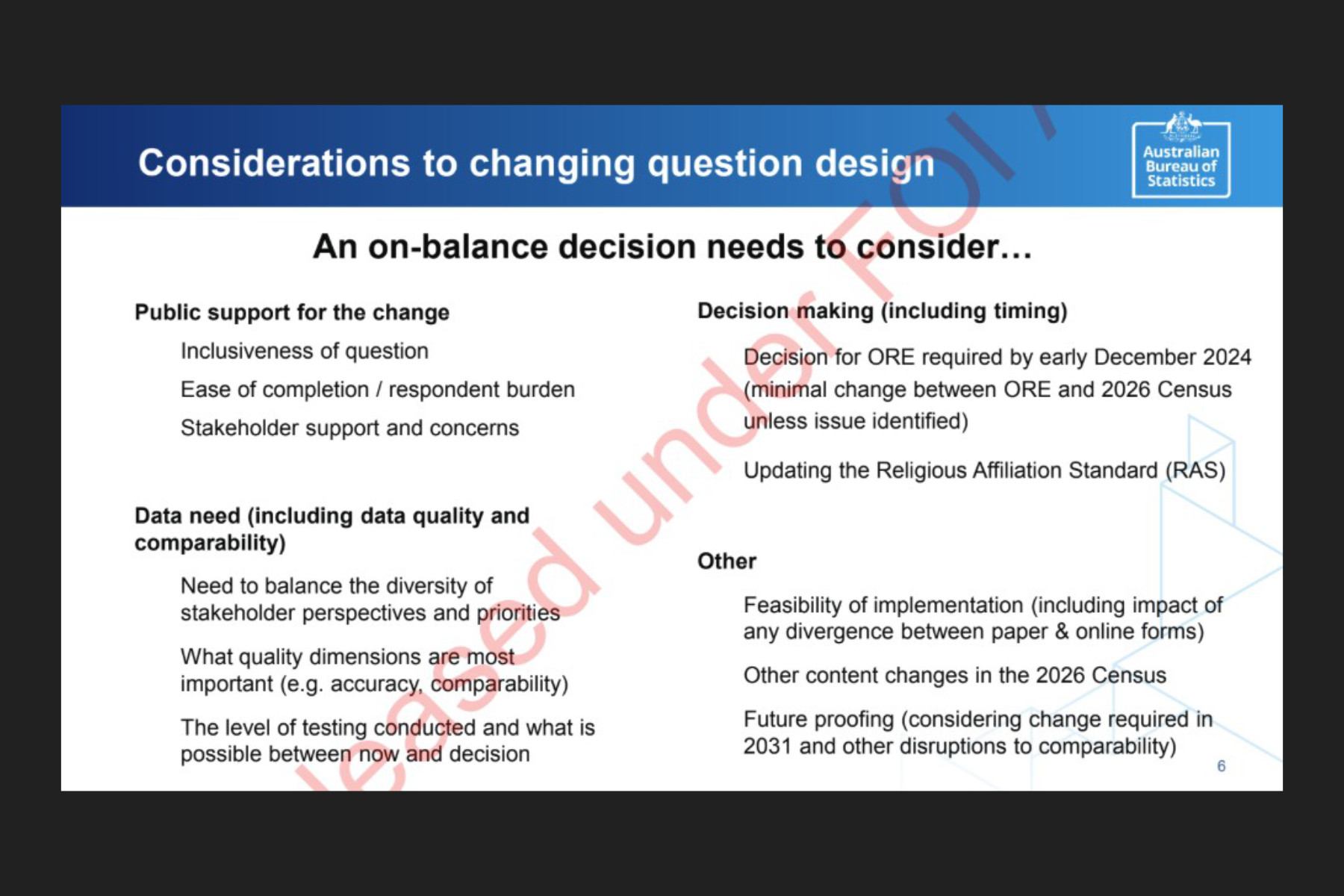
Slide 6 outlined that an “on-balance decision” needed to consider “public support for the change”, inclusiveness of the question, stakeholder support and concerns, and the “data need”, including to “balance the diversity of stakeholder perspectives and priorities”, and the quality dimensions in regards to data accuracy versus comparability with past censuses.
A slide detailing the options for the question’s response fields assessed the two remaining ‘potential options’ as the free-text field or a singular picklist with the 2021 response options – although, with these picklist options being reordered based on the frequency of affiliations recorded at the 2021 Census.
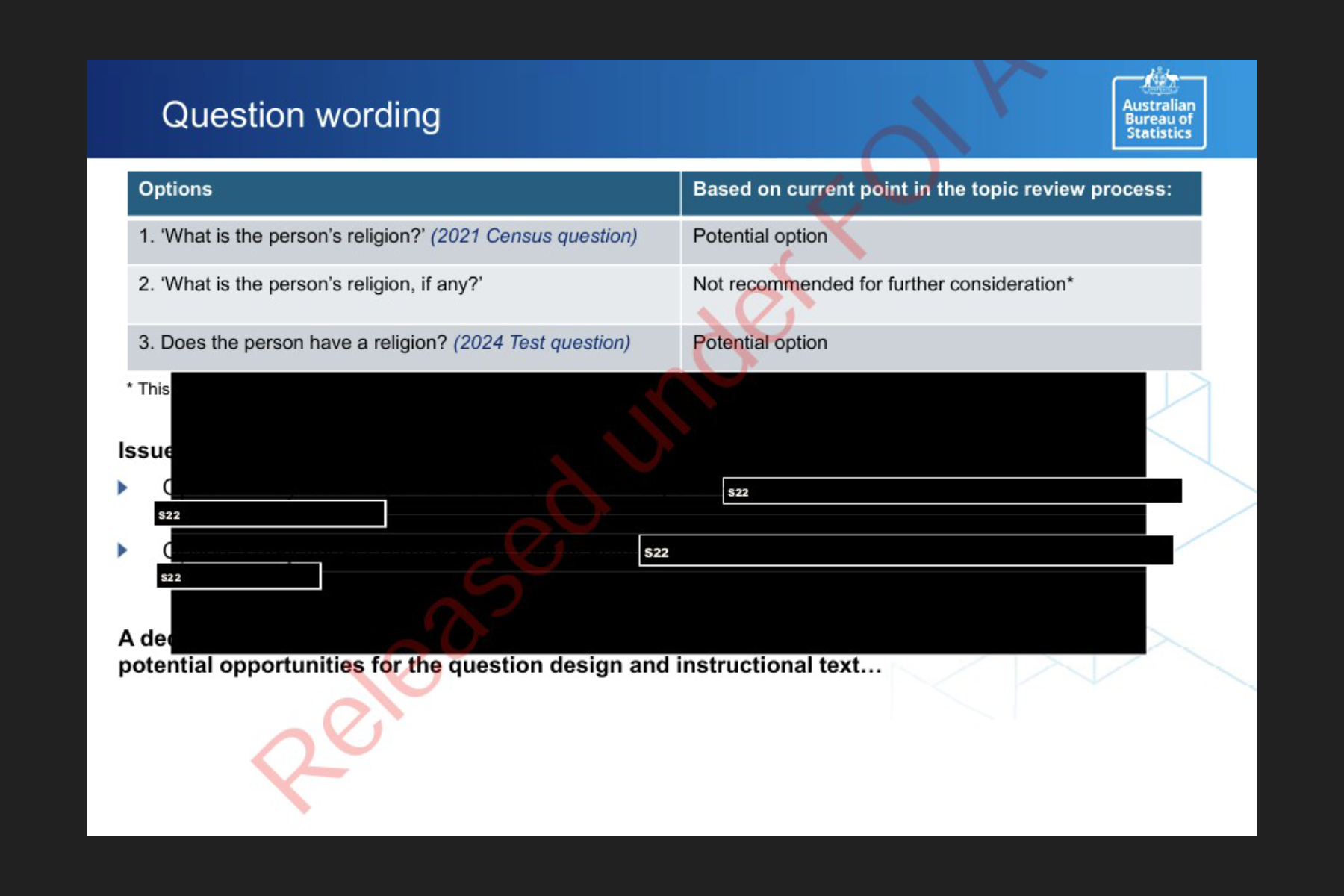
Slide 10 presented options for the question wording, with options 1 and 3 considered as ‘potential options’. Option 1 was reverting to the 2021 Census question: ‘What is the person’s religion?’ Option 3 was the question that the ABS had proposed to adopt for the 2026 Census: ‘Does the person have a religion?’ Option 2 – a variation to the 2021 question, adding ‘if any’ at the end – had already been discarded.
The bottom half of the slide was redacted, citing section 22 of the Freedom of Information Act (1982) (Cth) – which allows for “irrelevant” matter to be deleted.
However, this author was able to ascertain the hidden text simply by highlighting the section in the PDF that was provided by the ABS, copying the selected items, and then pasting it into a word-processing document. This process revealed that among the hidden text were the comments that option 1 “may lead respondents to a particular response” and that option 3 “may impact comparability significantly”.
The suggestion that option 1 – the biased question wording that presumes each respondent is religious – may lead respondents towards marking a religion will be of little surprise to anyone. Writing on the Pearls & Irritations blog in 2024, Michael Dove, the convenor of the ‘Census – Not Religious?’ campaign – a campaign supported by several non-religious and pro-secular groups, including the Rationalist Society of Australia, that encourages Australia to mark ‘no religion’ if they are not religious in order to country the effect of the question bias – said:
The existing question leads respondents to draw on their personal backgrounds, including parents’ religion, school attended, and previous practices and beliefs. None of these things are relevant to a person’s current relationship with religion.
… given that the purpose of the census is to take a demographic snapshot of the country and its evolving culture, we believe current and accurate data is more important than continuing to compare flawed data with flawed data.
For at least a couple of decades now, non-religious and pro-secular organisations have been actively calling on the ABS to remove the bias from the question because it inflates the Census data in favour of religion – as much as 11 points, according to several recent robust surveys, including one by Essential Research in 2021.
During the ABS’ two-year public consultation phase in 2022-23, the Australian public overwhelmingly called for the ABS to remove the bias from the Census question. Of 74 submissions relating to the proposed change to the religion question, the vast majority – 63 – supported the change and another eight partly supported it.
On 4 October 2024, the day following the meeting of ABS executives, confirmation of the outcome came via an email from Ms Carlton. Listed last – in eighth spot – of the outcomes relating to the religion question was the following statement:
It was also decided to retain the 2021 question wording for 2026 as this maximises comparability and we could not quantify the impact of question wording change without extensive testing.
The executives had also decided to retain the picklist approach for 2026. According to Ms Carlton:
This reflects feedback received from a number of stakeholders around the importance of comparability, and the significant impact the change would represent. There is also more significant burden associated with the free text box …
Having made its decision, the ABS set out to conduct additional cognitive testing to the minor variations to the 2021 question – such as the updates regarding the instructional text – with the aim of finalising the Census content by December.
A document circulated in mid October and titled ‘2026 Census Content Finalisation Cognitive Testing Plan’ outlined the way forward. But this document also provided some background information about the cancellation of September’s Census Test, describing the test as having been the “only opportunity for a quantitative test in the development and testing cycle prior to the topics, questions and forms requiring finalisation”.
Publicly, in the weeks following the cancellation of the test, the ABS had given no indication that it would be ditching its proposed religion question.
Given the uncertainty and some media reporting that suggested the new religion question would be impacted by the government’s announcement of its preferred topics and the subsequent cancellation of the Census Test, the ‘Census – Not Religious?’ campaign sought clarification from the ABS about the status of the religion question.
On 28 September 2024 – just days before its decision to revert to the 2021 religion question – the ABS confirmed, in a letter to the ‘Census – Not Religious?’ campaign, that the “version that was to be included in the 2024 Census Test continues to be tested”, and added that a mixture of testing methods would now be adopted. The statement added:
Evidence from the testing, alongside further feedback from ongoing stakeholder consultation, will support Dr Gruen’s decision on the final question approach.
Going into the Senate Estimates hearing on 21 November, Dr Gruen would have been expecting questions from Senator Dean Smith, the opposition spokesperson for the Census, regarding the status of the religion question.
When those questions came, Dr Gruen reported that the decision would be left to the “professional judgment of the ABS” and added that the ABS was “close to making a decision”:
As you are aware, that is a decision for us, not for the government. .. I’ve had a series of meetings with a large number of groups. We heard their views about the nature of the question that they would like asked on religious affiliation…. We had something like 10 meetings, I would say, with different groups, both religious and secular groups, and we are close to making a decision which I think we will announce in the new year.
Following the further rounds of testing on the 2021 question design, formal approval came in December from Deputy Australian Statistician Brenton Goldsworthy. In an ‘Executive Brief’ which identified the religion question as one of the “high risk” topics, he approved the question for use in the Operational Readiness Exercise (ORE) – a final major pre-Census test scheduled for 2025 – and noted the statement that questions for ORE would “largely reflect those to be used in the 2026 Census”.
The designation of “high risk” applied to topics that were either new or an “existing topic that requires trade-offs between data quality (including comparability between Censuses), support for the Census and compliance with anti-discrimination legislation.”
In summarising the reasoning behind the recommendation to retain the old question, the document made it clear that the argument for comparability with past censuses – made by the Catholic hierarchy initially and then religious lobbyists throughout 2024 – had triumphed in the absence of a major quantitative test of the proposed changes.
Consultation and engagement has highlighted that it is not possible to design a question that will meet the data needs for all users, and address inclusivity and data quality concerns identified with the current question design.
During the engagement in 2024, the ABS was presented with strong use cases on the need for comparability of data for the 2026 Census. These were not as evident when decisions on the 2024 Census Test questions were determined.
The 2026 Census testing program is not designed to accurately quantify or confidently surface all statistical impacts of question changes. As such, the ABS would be unable to support stakeholders who have a need for data comparability over time.
Given the inability to measure statistical impact, comparability has been prioritised for the 2026 Census.
In February 2025, the ABS finally announced publicly the questions it would be taking to the 2026 Census. In the non-religious and pro-secular community, there was deep disappointment that the ABS had, ultimately, failed to correct the obvious and long-standing problems with the religion question.
According to the ‘Census – Not Religious?’ campaign, the ABS “sacrificed accuracy in seeking to placate” religious interests, and the Census would “continue to provide an embarrassing case-study of how to create bias through poor questionnaire design”. In a statement, the campaign said:
The ABS had failed Australian taxpayers in choosing to continue with a fundamentally flawed question. … All Australians will lose out by not having access to representative and accurate data. This will have a significant impact on the quality of evidence to support policy formation and resource allocation.
On 11 August this year, the ABS will ask all households to complete the Census. Instead of delivering accurate information to the whole Australian public and the numerous users of religious affiliation data – such as researchers, governments at all levels, politicians, media outlets, and other institutions – the Census will again deliver inflated data that suits that narrow interests of religious groups.
Despite this, the 2026 Census is likely to be a watershed moment in Australian history, with ‘No religion’ (38.9% in 2021) on track to overtake Christianity (43.9%) and the total religion result set to fall below 50 per cent. Whatever the outcome, the Census data will still fail to provide a true picture of Australia’s relationship with religion.
The timeline of events, as detailed in The Census Files series, will no doubt raise concerns for many Australians about the influence of religious interests groups and perceived political interference on the ABS’ testing process. Still, the ABS has five years between censuses to fix the obvious problems with the religion question. And, yet again, it has failed to do so.
The ABS did get something right: it removed ‘Atheism’ from the examples of religious affiliations being presented with the question. Clap, clap.
Published on 31 January 2026.
If you wish to republish this original article, please attribute to Rationale. Click here to find out more about republishing under Creative Commons.
Image: Australian Bureau of Statistics