

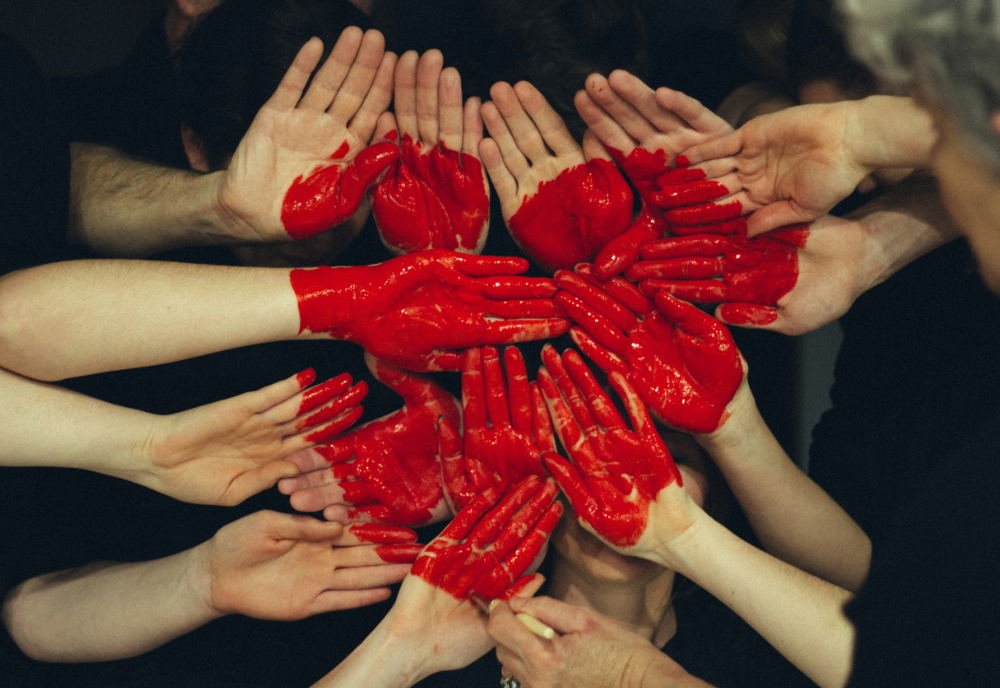
To me, empathy is being able to imagine, understand, and feel what it is like to be in another person’s shoes – to walk with them and to want to alleviate their suffering. Quintessentially, it is about how I would want to be treated if I was in their situation.
I always had a lot of sympathy for other people and I worked in the social justice area all my life. I felt moral indignation and intellectual disapproval when people were mistreated, but I could not feel their pain.
I remember watching a TV reporter talking to a man sitting on what remained of his house – the front step. There had been a big bushfire, and his house had burnt down. Nothing but the step remained. He had absolutely nothing left and not a person to help him through the trauma.
He was alone. He looked like a real battler. He broke down because he could not see how he could acquire the means to start again. I broke down too, the tears streaming down my face, a pain in my heart. And I suddenly realised that for the first time in my life I had experienced a moment of empathy and I was glad because I knew I would never be the same again.
Empathy is rational because it is part of human nature. Empathy is essential for human survival. It is hard wired into us. It helps us bond with our children and our friends, and strengthens our community ties. If we can show empathy, we can be trusted to help others when the going gets tough.
Research shows that people unconsciously mimic the actions and feelings of others through shared neural circuits. For example, brain scans show that when a person is in pain, certain brain regions activate, but, surprisingly, the same regions also activate when a person observes a loved one experiencing pain.
Amazingly, it seems humans have a powerful instinct to help others driven by a deep-seated empathy and the belief that all human life is valuable. I am very grateful for this because, at the age of 19, I was saved from drowning by a perfect stranger.
The empathy we feel for others is also influenced by our experiences, our environment, and connection to others. Empathy needs to be constantly practised to avoid complacency and indifference.
Empathy is rational because it underpins a good society. Attempts have been made to rank countries by their empathy, but such lists are not always helpful. Much depends on how empathy is demonstrated in a society and who benefits from it.
A 2016 study ranked Saudi Arabia as the second most empathetic country in the world – which is surprising given the conflicts that have occurred in this region, the conservative nature of the ruling elite, the restricted rights of citizens especially women, and the treatment of ‘guest workers’. In fact, the Saudi regime treats many people appallingly.
How could the survey get things so wrong? The survey relied on people answering an online survey and it did not differentiate between empathy felt for insiders and outsiders, between empathy felt for individuals or groups of people, between empathy felt for strangers or familiars, or between people with the same or different cultures.
Perhaps a better indication is how caring a society is. Caring is often a manifestation of empathy. Such a society seeks to look after all its citizens because all people are considered worthy of happiness. The top 5 ranked countries on the basis of happiness in 2025 were Finland, Denmark, Iceland, Sweden, and the Netherlands. These countries consistently score highest on happiness measures. Australia and New Zealand rank 11th and 12th respectively.
These are all countries where everyone is well cared for by a government ethos of empathy, if you like. This is achieved through robust social support systems that provide comprehensive healthcare and welfare, a high level of social trust, educational opportunities, as well as a strong emphasis on personal autonomy and a good work-life balance.
Elon Musk has controversially stated that empathy is the “fundamental weakness of Western civilization.” All evidence to the contrary, however. One thing empathy is not: weak. It takes a strong person to sit with another person and put their own views aside for a while and listen to what they have to say without judgement.
Empathy has nothing to do with manipulation. You retain your own views, if you wish. It simply means being cognisant of a different perspective. You just have to sincerely say. “I hear you.” Empathy is powerful because it gives us a more informed perspective so we can make better decisions to improve our society.
Empathy is rational because it nourishes us. The 2025 Happiness Report focussed on the impact of caring and sharing on people’s happiness. It states:
Like ‘mercy’ in Shakespeare’s Merchant of Venice, caring is “twice-blessed” – it blesses those who give and those who receive.
The 2025 Gallup World Poll asked people if they gave money to charity, if they volunteered, and if they helped a stranger. The results showed that people are far more benevolent than expected. For example, far more people returned wallets dropped in the street than expected.
Apparently, if we receive information about how truly benevolent people are in our society, it actually improves our wellbeing. A more benevolent, caring and empathic society benefits most people who are the least happy. It means happiness is more equally distributed in a society. I guess that someone who understands how you feel, and recognises your predicament, is far more encouraging than people disparaging you or saying that you deserve unfairness.
The empathy we feel for others is also influenced by our experiences, our environment, and connection to others. Empathy needs to be constantly practised to avoid complacency and indifference.
We all benefit from empathy. People who are empathetic, who care and share, and who are kind and benevolent, feel a warm inner glow, especially if they see the benefits for the recipient. One of the results of empathy is that people are treated as equals, and they then have a better chance of living up to their potential and, in doing so, contributing more to society.
Empathy is rational because it works against the rise of dictators. The World Happiness Report 2025 found that:
…the degree of benevolence in a country also has a profound impact on its politics. Populism is largely due to unhappiness. But whether populists are on the left or the right depends on trust. People who trust others veer to the left, those who do not veer to the right.
If a society is stratified, it allows some people to think they are superior, more deserving, more entitled than others. It means a lack of empathy is encouraged in society. Competition and individualism can accentuate this divide between groups and weaken empathy.
Dictators can tap into the division between groups in society by fostering resentment against a particular group especially if advantaged groups feel they might lose some of their entitlements. Many dictators work by increasing public prejudice, hatred and fear towards another group and making them into scapegoats for the imagined woes of the privileged. This may sound a familiar strategy to some readers.
Empathy is rational because if we didn’t have it life would be unbearable. There is a sub-group of humans who have very little or no empathy at all. They are often labelled as psychopaths or sociopaths. Some of them, but not all, can be dangerous.
At the very least, a lack of empathy can destroy relationships. There is one tremendous advantage of a lack of empathy, at least in the short term: you can do whatever you like no matter the cost to others.
A shocking example involves the United States of America’s Secretary of (Defense) War, Pete Hegseth. The White House confirmed on 1 December 2025 that the US launched a second strike on an alleged drug boat from Venezuela in early September, deliberately killing two unarmed survivors clinging to the wreckage.
The Washington Post reported that the second strike complied with an order from Secretary Hegseth to kill everybody.
When you have no empathy, you can casually be judge, jury and executioner. So far more than 80 people have been murdered in such so-called kinetic strikes on boats from Venezuela. These people were not identified and not charged with a crime. No evidence of a crime was produced, no trial was held. President Trump simply said:
I think we’re just gonna kill people that are bringing drugs into our country … We’re going to kill them. They’re going to be, like, dead.
A callous disregard for human life has been shown by the Israel government in Gaza. Doctor Abu Safia, the director of Kamal Adwan Hospital in North Gaza, was abducted by Israeli forces on 27 December 2024. Grave fears are held for his life, and there are credible reports of torture.
Israel continues to hold 80 Palestinian doctors and medical workers from Gaza and 15 from the occupied West Bank. A further five healthcare workers have died or have been killed while in Israeli detention, and five more are missing.
Attacks on non-political volunteers trying to help Palestinians in their desperate plight have been relentless. Over 1,500 health workers and hundreds of humanitarian workers have been killed in Gaza since October 2023. Among them have been 15 Médecins Sans Frontières staff members. Unfortunately, Jewish civilians have also paid a terrible price for this ongoing and relentless conflict.
This isn’t a new phenomenon. These sorts of things happen when those in power are devoid of empathy. Some people admire such people as strong leaders who will stand up to their real or imagined enemies. But a leader without empathy is likely to ruin the lives of many people because they can be ruthless and cruel. History shows us that they are quite capable of getting rid of supporters as well as foes.
Lack of empathy could even be considered to be the root of all evil, if you believe in such a thing. Certainly, the world being built by Donald Trump, a man I believe to be without empathy for anyone or anything, is terrifying.
On the other hand, others believe that empathy is our most precious human characteristic and can lead to healing and resolution, in place of conflict. I am one of these people.
Published on 17 December 2025.
If you wish to republish this original article, please attribute to Rationale. Click here to find out more about republishing under Creative Commons.
Photo by Tim Marshall on Unsplash.